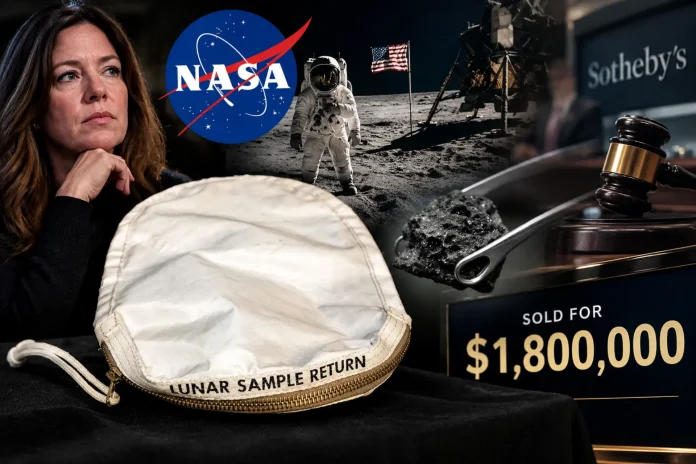
Nancy Lee Carlson, a real estate attorney from Inverness, Illinois, bought a white zippered bag stamped “Lunar Sample Return” for $995 at a U.S. Marshals Service online auction in February 2015. Two years later, after NASA identified it as the Apollo 11 contingency sample bag used by Neil Armstrong and lost a court battle to reclaim it, she sold the artifact at Sotheby’s in New York for $1,812,500.
The sale took place on July 20, 2017, the 48th anniversary of the Apollo 11 moon landing. Sotheby’s had estimated the bag at $2 million to $4 million. An anonymous phone bidder paid the final price, which included the buyer’s premium after a $1.5 million hammer price. Carlson, born November 15, 1954, in Marquette, Michigan, had graduated from Northern Michigan University in 1974 and earned her law degree from Thomas M. Cooley Law School in 1985 before practicing in the Chicago suburbs.
Armstrong used the bag on July 20, 1969, at Tranquility Base to hold a contingency cache of lunar rocks and soil. It served as the outer decontamination bag protecting the first samples collected during the mission. The white Beta-cloth pouch, roughly 12 by 8.5 inches with a brass zipper and part number V36-788034, still carried traces of lunar dust when Carlson acquired it.
The bag’s path to the auction began with Max Ary, who directed the Kansas Cosmosphere and Space Center in Hutchinson from 1976 until 2002. Federal investigators found the pouch among items in Ary’s garage during a 2003 search related to missing museum artifacts. Ary was convicted in 2005 on 12 federal counts including theft of government property, wire fraud and money laundering. He was sentenced in 2006 to three years in prison and ordered to pay about $132,000 in restitution.
A clerical mix-up in inventory records led officials to treat the Apollo 11 bag as a less significant flown item. The U.S. Marshals Service put it up for sale to help cover restitution. Earlier auction attempts with a higher minimum drew no bids. On Feb. 17, 2015, Carlson won it for $995 along with a mesh cushion.
Carlson, a longtime space history enthusiast who had watched the Apollo landings as a child in Michigan, stored the bag in a closet. She later sent it to NASA’s Johnson Space Center in Houston for authentication. Ryan Zeigler, the Apollo sample curator, confirmed the presence of lunar dust matching Tranquility Base material. NASA determined the bag had flown on Apollo 11 and refused to return it, arguing it remained government property that had never been properly released.
Carlson sued. In December 2016, U.S. District Judge J. Thomas Marten in Kansas ruled that she was “a good faith purchaser, in a sale conducted according to law.” Marten noted the government lacked authority to unwind the completed Marshals sale even though the bag should not have been offered. A Texas federal judge later ordered NASA to hand it over. Officials returned the bag to Carlson at the Johnson Space Center in late February 2017.
Carlson’s attorney, Christopher McHugh of a Kansas City firm, described the outcome as unique. “It’s what every collector wants,” he said. “You want to find the thing that’s super special.” Carlson later said she decided against keeping the bag at home for security reasons and consigned it to Sotheby’s. She planned to direct some proceeds to charities including the Immune Deficiency Foundation and a Michigan children’s therapy center, plus a scholarship at her undergraduate university.
Subsequent litigation addressed lunar particles lifted onto testing tape and alleged damage to the bag during analysis. Those matters were resolved separately, with NASA returning most of the material and making a payment to Carlson. The anonymous Sotheby’s buyer has not publicly identified the bag’s current location.
The episode remains one of the few instances in which a private individual obtained clear title to a lunar artifact that the U.S. government had previously sold by mistake. Court records from the District of Kansas and the Southern District of Texas, along with contemporaneous reporting from collectSPACE and other outlets, document the sequence from the Cosmosphere seizure through the final auction.