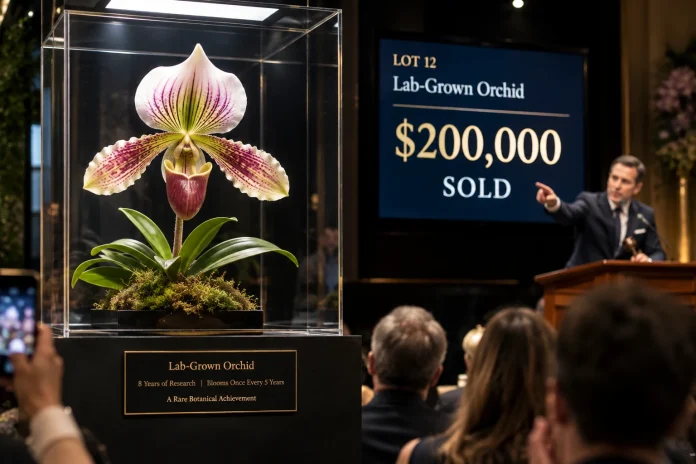
In 2005, a single orchid plant developed entirely in a Chinese laboratory sold for approximately $200,000 at auction, cementing its place as one of the most expensive flowers ever publicly sold. The Shenzhen Nongke Orchid, named after the research institution that created it, remains a striking example of how scientific patience and controlled cultivation can transform a flower into a high-value collector’s item.
Agricultural scientists associated with the Shenzhen Nongke Group (or Shenzhen Nongke University) in Shenzhen, Guangdong province, spent roughly eight years developing the hybrid through advanced hybridization, tissue culture, and tightly controlled growing conditions. The work, which began in the late 1990s, focused on producing a plant with distinctive beauty, slow growth, and high rarity. Unlike wild orchids, the Shenzhen Nongke does not occur in nature. Early specimens were raised under precise laboratory conditions involving specialized light, temperature, humidity, and nutrient regimens, with little or no soil exposure in many accounts.
The resulting plant features elegant blooms with petals in shades of light green, chartreuse, or yellow-green and a brighter, often complexly marked center or labellum. Descriptions highlight its symmetrical form and refined appearance. The plant typically reaches about 60 centimeters in height when mature and is a perennial that can live for decades with proper care. Its most notable trait, however, is its flowering cycle: the orchid blooms only once every four to five years, with individual flowers lasting several weeks under attentive conditions. From the early stages of cultivation to the first bloom can also require multiple years, adding to its exclusivity.
In 2005, one specimen was auctioned for 1.68 million Chinese yuan—equivalent to roughly $200,000 to $202,500 USD at the time (some contemporary reports approximated £160,000). The buyer was reported as anonymous, though a few secondary accounts have suggested a Taiwanese collector. The price reflected the combination of scientific achievement, years of dedicated research, limited supply of the original plants, and strong collector demand. At the time, the plant was not available through ordinary commercial channels and relied heavily on cloning or micropropagation rather than seed production.
Two decades later, the Shenzhen Nongke Orchid continues to be cited in lists of the world’s most expensive flowers alongside the priceless Kadupul flower of Sri Lanka, the high-development-cost Juliet rose, and rare wild species such as the Gold of Kinabalu orchid. Advances in tissue culture have allowed limited specialized production in controlled Chinese facilities, and later private-market valuations for mature plants have been reported in the tens of thousands of dollars rather than the original record figure. Export and open commercial availability remain restricted in many accounts due to intellectual-property considerations.
The story of the Shenzhen Nongke Orchid illustrates both the technical possibilities of modern horticultural science and the enduring appeal of rarity in the ornamental plant market. What began as a research project in plant cultivation techniques produced a bloom whose value was measured not only in aesthetics but in the time, expertise, and scarcity invested in its creation.