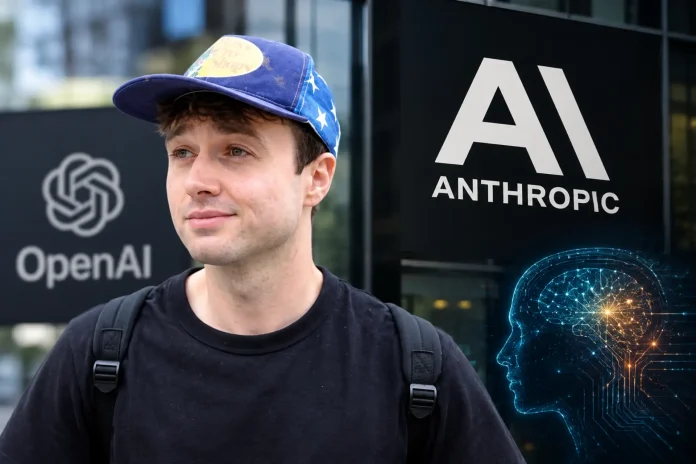
Jacob Coxon, a 27-year-old British researcher who specialized in pretraining AI models, resigned from Anthropic on Tuesday and said he is leaving the AI industry entirely.
In a series of posts on X, Coxon wrote that he spent the past three years on pretraining research at both OpenAI and Anthropic.
“Neither company is acting responsibly,”
he said.
“They are racing straight to self-improving superintelligence and gambling with our lives.”
Coxon warned that advanced systems would soon become superhuman.
“These will soon be superhuman systems that can hack anything, revolutionize any field overnight, and acquire real power and resources,”
he posted.
“We have all witnessed the progress in each of these domains, and progress is not slowing.”
He added that people inside the labs privately share serious fears.
“The people building AI earnestly believe that it could kill us all by the end of the decade,”
Coxon wrote.
“This is not a marketing stunt. If anything, many executives and senior researchers will couch their phrasing in the press to sound sensible. But I hear the same people express fear privately. No other human activity poses this level of danger.”
Coxon drew a sharp distinction between the two labs. At OpenAI, he said, many have not deeply internalized the civilizational stakes. At Anthropic, the picture is different. The risks are well understood, but the company still races to reach the technology first, on the belief that no one else will act responsibly.
“Accepting this race and entering the ‘endgame’ is a hubristic gamble that should not be launched from a private company’s Slack,”
Coxon wrote. He called for stronger measures: pacing agreements among US labs, and even temporary bans on improving model capabilities, all to head off a global race that could spiral beyond control.
That proposal is not new. In July 2026, a coalition of AI researchers and lab executives signed an open letter called “Pacing the Frontier,” which argued that frontier labs should voluntarily pause the next capability jump until safety review catches up. The letter was signed by Anthropic’s leadership, OpenAI’s chief scientist Jakub Pachocki, and DeepMind’s Demis Hassabis, among others.
In an interview with The Wall Street Journal, Coxon said researchers inside frontier labs increasingly use the words “crunchtime” and “endgame” to describe where the technology is headed.
“We’re on track for a lot of the most aggressive of these scenarios where by the end of next year things could be out of control already,”
he told the newspaper.
Coxon joined OpenAI’s technical staff in 2023 and contributed to work on GPT-4o before moving to Anthropic in July 2026, drawn by the company’s public emphasis on safety and alignment. His departure is part of a broader wave of safety-focused exits from frontier labs over the past two years, including OpenAI’s Jan Leike and Ilya Sutskever, several Anthropic alignment-team researchers in 2025 and 2026, and a string of mid-level researchers from DeepMind and Meta’s Superintelligence Lab.
Evan Hubinger, Anthropic’s Alignment Science lead, publicly backed Coxon’s warning. “Jacob is correct here,” Hubinger posted on X.
“We really do earnestly believe AI could kill all humans. I personally think it is greater than 10% within the next decade. I believe Anthropic is trying its best, but we do not yet have a plan to solve alignment for superintelligence and are not clearly on track to.”
Hubinger clarified in a follow-up post that current AI models pose low risk, but expressed concern about superintelligence arising through recursive self-improvement, the technique where AI models are trained on outputs produced by earlier versions of themselves, which he said is happening faster than previously expected.
Anthropic has not issued an official statement on Coxon’s departure. CEO Dario Amodei, in his September 2026 essay on superintelligence risk, argued that the potential benefits of advanced AI in science and medicine are large enough to justify continued development, but only if proper safeguards are pursued in parallel.
“We are building something that could either transform civilization or end it, and we have to choose which,”
Amodei wrote.
Coxon’s resignation lands roughly eleven months before the first major US AI safety bill is expected to reach a congressional floor vote. The Frontier Model Safety Act, introduced in March 2026, would create a federal review board for the most capable AI systems and require labs to publish safety plans before training new model generations. It has bipartisan support but has stalled over preemption disputes with state-level AI laws.
Coxon closed his thread with a direct appeal to his former colleagues.
“If you are a lab researcher, I urge you to consider what the next few years will actually feel like,”
he wrote.
“Do you want to kick off a superintelligent RL run without a rigorous understanding of its mind? Should you put your head down because it’s happening anyway, or take this moment to call for different conditions?”