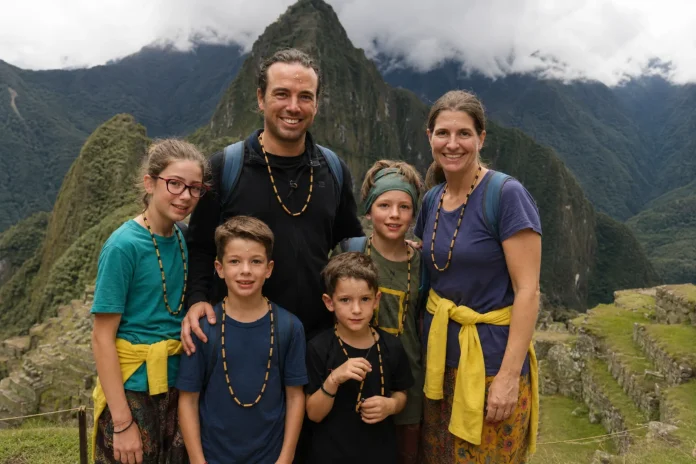
A Montreal-area family packed up in 2022 and spent more than a year circling the planet so three of their four children could stockpile the sights they may one day lose. Edith Lemay and Sébastien Pelletier left Boucherville, Que., with Mia, Léo, Colin and Laurent after doctors confirmed that Mia, Colin and Laurent have retinitis pigmentosa, a rare inherited condition that slowly destroys the retina.
Léo does not have the disease. The other three already struggle in the dark. Night blindness showed up first. Peripheral vision is next. Many people with the same diagnosis reach legal blindness by midlife. There is no cure that matches the recessive gene both parents carry.
Mia was three when she started bumping into furniture after sunset and dropping toys handed to her in dim rooms. Genetic testing took years. The family got her diagnosis in 2018, when she was seven. Colin and Laurent were confirmed later that year and into 2019. Both adults learned they are silent carriers of the same gene. Each child had a one-in-four chance. Three of four drew it.
Lemay, a data analyst in the medical field, has said the first stretch felt like grief. Anger. The unfairness of it. Then a school-board specialist offered a practical line: fill their visual memory. Look at pictures of giraffes and elephants so the images stay when the eyes fail. Lemay and Pelletier flipped the advice. They would take the kids to the animals.
“I thought, I’m not going to show her an elephant in a book, I’m going to take her to see a real elephant,”
Lemay told interviewers during the trip.
“And I’m going to fill her visual memory with the best, most beautiful images I can.”
They had wanted a long journey even before the diagnoses stacked up. A 2020 plan to ride the Trans-Siberian Railway through Russia, Mongolia and China died when COVID closed borders. Pelletier, a financial consultant for startups, watched as the timing lined up with his work. Lemay called the moment a gift. They rented the house, quit their jobs, and left Montreal in 2022 with a loose list instead of a locked itinerary.
The kids named activities, not countries. Mia wanted horseback riding. Colin wanted to sleep on a train. Laurent wanted to drink juice on a camel. Léo wanted to swim with sharks. Those wishes steered the year.
Namibia came first. Quiver trees, desert camps, Cape fur seals on the Atlantic coast, giraffes close enough that Léo asked if they were real. Zambia and Tanzania followed, including the slow Tazara railway Colin had asked for and a 24-hour ride he still talks about. They hiked near Kilimanjaro. They danced with Maasai families. A hot-air balloon over Cappadocia, Turkey, landed on Laurent’s birthday. Mia cried on horseback in the Mongolian steppe. The children played with a baby reindeer. In Indonesia they surfed. In Egypt they finished a wish involving a camel and juice.
The route grew as they moved. Nepal was not on the original map. The kids played soccer with local children and with young monks outside a Kathmandu monastery, according to The New York Times. Language did not matter once a ball was in play. In Ecuador they fished and learned blowpipes with an Achuar boy named Gustavo. The families still exchange messages.
Counts differ across interviews, but the family has described roughly 13 to 15 countries across Africa, Asia and the Americas, CBS News reports. Radio-Canada reported the trip lasted 384 days on a budget of about $120,000 Canadian, flights included. They traveled by train whenever they could. They home-schooled French and math out of three suitcases. Kids still argued.
They landed back in Quebec in the spring of 2023, per The Boston Globe. Friends and school pulled the children in faster than the parents expected. Mia said sitting still was the hard part. Léo’s advice was blunt: go instead of talking yourself out of it. If you question yourself too much, you miss the train.
Lemay documented the year on Instagram under Plein Les Yeux and on the blog Le monde plein leurs yeux. Followers climbed past 100,000. She later turned the notes into a book, Le Monde Plein Leurs Yeux, and recorded an audiobook so the kids will still have the story if print becomes harder to use. The family-account viral phenomenon has drawn imitators abroad, including a French TikToker who later admitted to faking a dog kidnapping for views. National Geographic released the feature documentary Blink in 2024, directed by Daniel Roher and Edmund Stenson, the team behind the Oscar-winning Navalny. The film premiered at Telluride, played theaters in October 2024, and later streamed on Disney+ and Hulu.
Progression has been slow so far. Night vision is already gone for the three who carry the mutation. In January 2024, Edith took Mia, Colin and Laurent to the UPMC Vision Institute in Pittsburgh to see Dr. José-Alain Sahel, a leading retinitis pigmentosa researcher. The children were too young and still too healthy for the trials on offer. The family stayed in the loop for later studies. Their Montreal ophthalmologist has treated other Quebec children with Luxturna, a gene therapy that does not target their specific mutation.
Lemay has repeated the same stance since the diagnoses landed. She does not want the kids to treat the disease as a sentence that owns them.
“I don’t like to feel like a victim,”
she told CBC.
“I like to take control and that’s something I’m really trying to pass on to my children too.”
Pelletier put the clock in simpler terms during the year on the road: with the diagnosis, they had urgency.
The souvenirs they wanted were never fridge magnets. They wanted giraffes that breathe, a train that rattles all night, a balloon that lifts off a Turkish valley at dawn, and a stack of faces from villages that never made the original list. Those pictures are in the children’s heads now. The rest of the work is slower. Appointments. New research. Ordinary school days in Montreal. And the question Laurent asked from a van in Mongolia when he was five: what does it mean to be blind?
For Hypefresh’s related reporting on Americans facing emergencies abroad, see our coverage of the Ashlee Jenae death in Zanzibar and our piece on the ‘Call Me Slo’ Bali prison case.