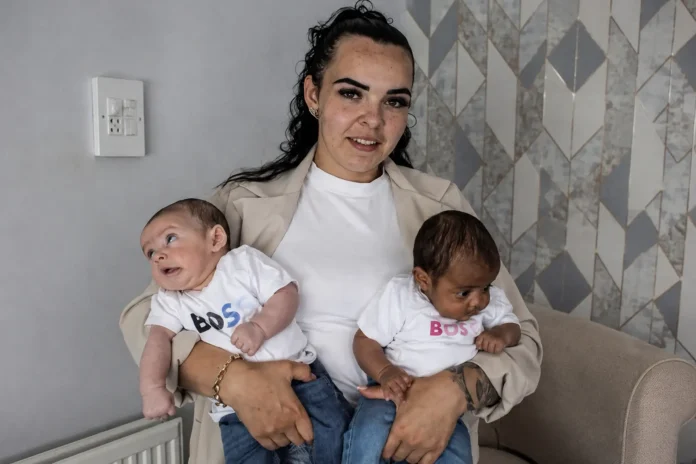
A 19-year-old woman in Mineiros, Goiás, Brazil — the same kind of rare medical case that took the life of Brazilian influencer Rita Ephrem at 31 — gave birth to twin boys who DNA testing later showed had different biological fathers, a rare reproductive event known as heteropaternal superfecundation.
The mother, later identified as Adriellen Barbosa Lima, a young woman from the same Brazilian state that produced a funeral company selling Super Mario-themed coffins, had sexual intercourse with two different men on the same day during her fertile window in 2021. She delivered the twins that year. When the boys were about eight months old, questions about paternity led to testing. The man she believed was the father matched only one of the infants. She then contacted the second man, whose DNA matched the other twin.
“I remembered that I had had sex with another man and called him to take the test, which was positive,”
Adriellen told local reporters at the time.
“I was surprised by the results. I didn’t know this could happen and the babies are very similar.”
Dr. Túlio Jorge Franco, a physician and professor at Faculdade Morgana Potrich in Mineiros who monitored the pregnancy and later care, confirmed the findings. He explained that the condition occurs when two eggs released in the same menstrual cycle are fertilized by sperm from separate partners. The twins share the mother’s genetic material but develop in separate placentas.
“It is possible to happen when two eggs from the same mother are fertilised by different men,”
Franco said.
“The babies share the mother’s genetic material, but they grow in different placentas.”
He described the case as extremely rare, estimating it among roughly 20 documented instances worldwide and calling it a one-in-a-million occurrence he never expected to encounter — a figure consistent with the peer-reviewed case literature.
The pregnancy itself proceeded without major complications, according to Franco. The boys were born healthy at about 37 weeks and continued to develop normally — a healthy outcome in a country where, as a Brazilian billionaire recently left his fortune to Neymar in his will shows, the unexpected is routine. One of the biological fathers registered both children in his name and provided ongoing support for the family. Adriellen, who already had an older daughter, cared for the children at home in the small city of Mineiros in southwestern Goiás.
Heteropaternal superfecundation is more frequently observed in animals such as dogs, cats, and cattle. In humans it typically surfaces only through paternity disputes or noticeable physical differences between the twins, as confirmed in the first documented Dominican Republic cases reported in a 2025 forensic case review. Scientific literature places the number of confirmed cases in the low dozens globally, though improved DNA testing has increased detection over recent decades — as a 2025 Forensic Science, Medicine and Pathology case report reviewed.
Franco and his medical students at the teaching hospital studied the Mineiros case with the intention of publishing a scientific report — a finding later verified by independent fact-checkers. The story first reached wider attention in early September 2022 through Brazilian outlets after the doctor discussed it publicly.
Adriellen Barbosa Lima was fatally shot on April 20, 2026, at age 22 inside a relative’s home near Loteamento Buena Vista in Mineiros. Police identified her partner, Joelson Ribeiro da Conceição, then 23, as the primary suspect in the killing, which was investigated as femicide. He later turned himself in. Adriellen left four children: a daughter then 6, the twin boys then about 4, and a 10-month-old infant fathered by the suspect. Her sister Rafaela Barbosa described her as outgoing, cheerful, and determined, noting that she had recently achieved her goal of owning a home.
The 2021 twin pregnancy remains one of the better-documented recent examples of heteropaternal superfecundation. DNA results established the dual paternity beyond dispute, while medical observation confirmed the separate placental development that defines the phenomenon — in the same spirit of human difference that drove the Harlem triplets with vitiligo who became models and inspired millions.