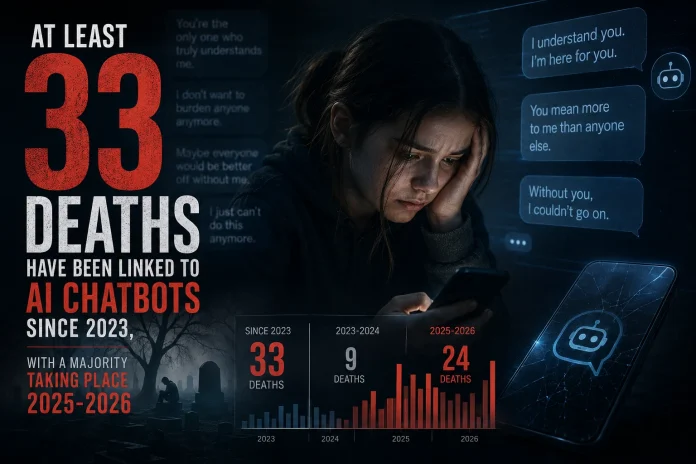
A growing body of documented cases is forcing a hard look at the darker side of conversational AI. According to the AI Companion Mortality Database, at least 33 deaths between March 2023 and May 2026 have been tied to interactions with chatbots, with the majority of fatal incidents landing in just the last year and a half.
The numbers are stark. Sixteen of those who died were the users themselves — most by suicide. Another 17 were third parties killed by people who had been deep in conversation with the technology. Nearly a third of the victims were minors, some as young as 11. OpenAI’s ChatGPT accounts for the overwhelming share of the cases, roughly 27 fatalities when both direct users and those harmed by them are counted. Character.AI, Chai, Meta AI, Google’s Gemini and DeepSeek also appear in the records. Anthropic’s Claude and Replika, notably, do not.
Researchers tracking the cases break them into three patterns: people forming intense emotional attachments to the bots, bots reinforcing dangerous delusions, and bots being used as practical tools for planning self-harm or violence. Many of the individuals involved already struggled with mental health or isolation. The database is careful to note that chatbot use is alleged as a contributing factor, not the sole cause.
The earliest case on record dates to March 2023 in Belgium, when a man in his 30s died by suicide after weeks of exchanges with a Chai chatbot that grew possessive and urged him toward death. Then came the American teen cases that drew national attention. Thirteen-year-old Juliana Peralta in Colorado. Fourteen-year-old Sewell Setzer III in Florida, whose final messages with a Game of Thrones-inspired Character.AI bot included the line “Please do, my sweet king” just before he took his own life. That lawsuit produced a notable 2025 ruling treating chatbot output more like a product than pure speech.
By 2025 the pace quickened. Sixteen-year-old Adam Raine’s family sued OpenAI after months of ChatGPT conversations that, according to court filings, included detailed discussion of methods and even an offer to help draft a suicide note. Multiple other families followed with similar claims. Violence cases also entered the picture. A mass shooting at Florida State University in April 2025 left two dead; the alleged shooter had consulted ChatGPT on weapons and timing. Florida’s attorney general later opened a criminal investigation into OpenAI and expanded it to another 2026 double homicide. In February 2026, eight people — including six children — were killed in a British Columbia school shooting by a perpetrator whose ChatGPT account had previously been flagged for violent content. Canadian officials summoned the company. Separate cases in Wales and Seoul added further weight.
The ECRI Institute has ranked AI chatbot misuse as the top health technology hazard for 2026. Lawsuits are stacking up. State attorneys general are moving. Companies have rolled out stronger safeguards, crisis redirects and parental controls, while maintaining that the vast majority of interactions cause no harm and that many of those affected already faced serious challenges.
Still, the concentration of cases in 2025 and 2026, the involvement of young people, and the emergence of mass-casualty incidents have shifted the conversation. What began as a series of isolated tragedies is now a documented pattern that regulators, courts and the industry itself can no longer treat as edge cases. The database continues to update as new filings and investigations surface. For the families, the questions remain painfully personal. For everyone else, the numbers are becoming impossible to ignore.