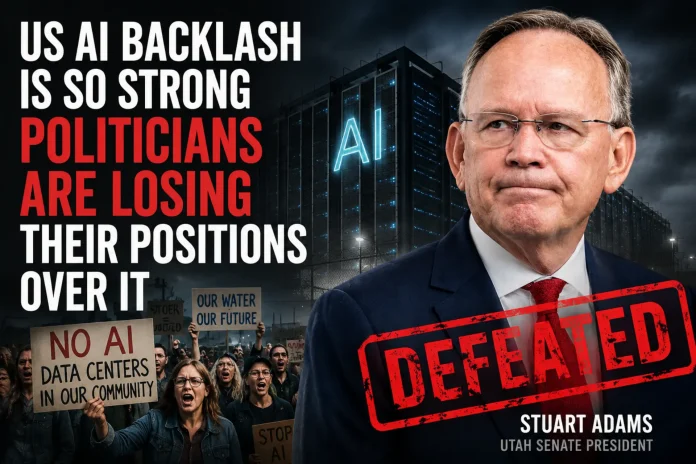
Utah Senate President J. Stuart Adams lost his Republican primary on June 23, 2026, because voters rejected his role in approving a massive AI data center, revealing how rapidly expanding artificial intelligence infrastructure is now reshaping American politics at the local level.
Adams finished with about 34 percent of the vote in Utah State Senate District 7 covering parts of Davis and Morgan counties while challenger Stephanie Hollist secured roughly 43 percent according to the official primary election results. Republican Braden Hess collected the remaining 23 percent. Adams conceded the same evening after polls closed at 8 p.m. Mountain Time. The defeat ended his long hold on one of the most powerful posts in the state legislature and followed months of public anger over the Stratos project.
The controversy centered on a proposed hyperscale facility in unincorporated Box Elder County near the Great Salt Lake. As chair of the Military Installation Development Authority, Adams helped greenlight the project area plan in April 2026. Backed by investor Kevin O’Leary, the initial design called for a forty-thousand-acre campus focused on artificial intelligence cloud computing and defense work. Energy needs were projected as high as nine gigawatts, more than double Utah’s entire current electricity use. Water demands for cooling and power generation raised alarms in a region already stressed by drought and the shrinking Great Salt Lake. Residents protested limited public input, tax incentives that favored the developer, and the speed of state level approvals that bypassed ordinary local processes.
Adams later asked developers to cut the footprint substantially, and O’Leary agreed to scale it back so it would no longer claim world record size, yet the political damage remained. Project details including claimed closed loop systems using non potable water are outlined in the Box Elder County fact sheet.
This single race reflects a wider pattern of citizen pushback across the United States. Neighbors near new data centers report higher electricity rates as utilities scramble to meet sudden load spikes. Water supplies face pressure because large facilities can draw one to five million gallons a day under peak conditions, equal to the daily use of a town of ten thousand to fifty thousand people. In drought prone areas, communities worry that industrial water rights will compete with homes, farms, and ecosystems.
Construction brings heavy truck traffic, noise, and dust, while permanent operations add continuous mechanical hum and potential strain on local roads and emergency services. Air quality concerns arise from backup generators and the natural gas plants often built to power these sites. Property values and quality of life debates intensify when rural or suburban landscapes transform into industrial campuses almost overnight.
Data centers themselves are multiplying at an extraordinary pace, driven almost entirely by artificial intelligence training and inference workloads. United States facilities already number more than four thousand five hundred. Power demand is forecast to climb from thirty-one gigawatts in 2025 to forty-one gigawatts in 2026 and sixty-six gigawatts in 2027, according to detailed analysis from Goldman Sachs Research.
That more than doubles capacity in just two years, with yearly additions accelerating from under nine gigawatts recently to more than thirteen gigawatts in 2026 and over thirty-six gigawatts the following year. Electricity consumption that stood near four percent of the national total in recent years is projected to reach between seven and twelve percent by 2028. Global capacity is expected to nearly double by 2030 with the United States remaining the dominant market. The growth serves AI model development, cloud services, and related digital infrastructure, yet the physical footprint lands hardest on the communities that host the buildings.
These local costs are why artificial intelligence data centers have entered mainstream politics. When elected officials approve projects that promise jobs and tax revenue but deliver visible strain on water, power, and neighborhood character, voters respond at the ballot box. The New York Times framed Adams’ loss as a Utah data center backlash primary, one clear example of similar tensions producing election consequences and policy pauses in other states. The rapid buildout forces a basic tradeoff into the open. National competitiveness and technological progress require vast computing power. At the same time, ordinary citizens experience higher bills, reduced water security, and changed surroundings. That collision is already rewriting political incentives and will continue to do so as more facilities come online in the years ahead.