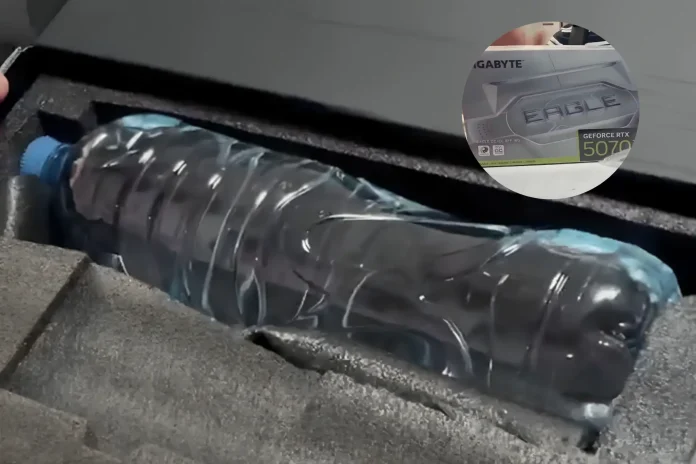
A Moscow buyer paid roughly $1,100 for what looked like a brand-new Gigabyte GeForce RTX 5070 Ti and walked away with a two-liter bottle of water instead. The unboxing video, filmed at a Wildberries pickup point and shared on X by user @oldValkyrie, spread fast across tech circles on July 30, 2026, turning a single package into a flashpoint for online shopping risks.
According to reports, the customer ordered a Gigabyte GeForce RTX 5070 Ti Eagle OC Ice for about 90,000 rubles. Suspicious after earlier platform complaints, he recorded the entire hand-off. An employee passed over the package. The outer shrink-wrap and serial label looked intact on camera. Inside the foam, sitting where the graphics card should have been, was a sealed 2-liter plastic water bottle chosen to match the expected weight.
@oldValkyrie described the clip as coming from a friend of her husband. Multiple Russian hardware sites, including i2HARD and iXBT, and international outlets picked it up the same day. The on-site recording is what made the story stick: it starts before the box is opened and shows staff present, making a simple “buyer did the swap” explanation harder to sell.
NVIDIA’s RTX 50-series cards remain high-value targets. The 5070 Ti launched with strong 1440p and 4K performance, 16 GB of GDDR7, and street prices that often climb well above the $749 MSRP. In a tight launch window, a resealed box that still weighs the same can slide through warehouse checks that rely mainly on scales and external appearance.
The method described in coverage is familiar: remove the card, insert a weighted stand-in (grain, rocks, bottles), reapply the protective film sometimes with a heat gun and return the package. Earlier this year another Wildberries customer reportedly received a bag of grain in place of an RTX 5080. That buyer waited more than two months for a full refund, and only after prosecutors stepped in.
Tech outlets and consumer advocates alike have long advised customers to invest in expensive hardware. In particular, filming the unboxing process from start to finish, checking the product’s seals and serial numbers, and comparing them to a bill issued upon arrival at the pickup point. These recommendations are supposed to help avoid scams where dishonest dealers claim that the client swapped the product with a lower-end model by themselves.
The Moscow water-bottle scandal has shown that the described practice cannot be taken as an ultimate guarantee of truthfulness. It may significantly reduce the chances of falling for one, however, at least until more tangible evidence is presented. Graphics cards, CPUs, and other expensive computer parts will continue to be a target for dishonest sellers as long as the demand for them and their re-sale value remain relevant. Until a third party presents credible proof (e.g., a complete set of invoices, an unaltered packaging, or another type of verification), everyone should carefully consider both the consumer’s allegations and the seller’s response.