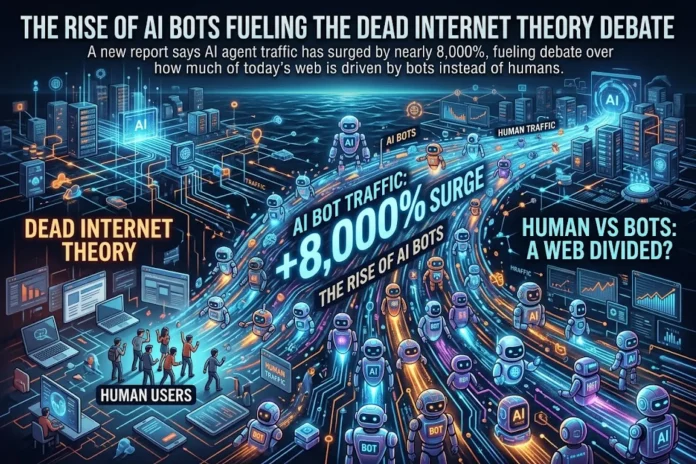
AI agent traffic surged nearly 8000 percent year over year according to detailed cybersecurity measurements, and automated systems now generate the majority of webpage requests across the global internet, confirming that bots outpace humans in online activity and giving concrete substance to the Dead Internet Theory.
The shift unfolded across precise timelines and data sources. In March 2026 the HUMAN Security team released its State of AI Traffic and Cyberthreat Benchmark Report after analyzing more than one quadrillion interactions on its platform throughout 2025. That report documented agentic AI traffic rising 7851 percent, AI driven volume nearly tripling overall, and automated traffic advancing eight times faster than human traffic. By early June 2026 Cloudflare Radar recorded the historic crossover when bots accounted for 57.5 percent of HTTP requests to HTML content while humans stood at 42.5 percent. Cloudflare CEO Matthew Prince noted the milestone arrived more than a year ahead of earlier forecasts because agentic systems accelerated so sharply. The numbers continue to circulate widely in July 2026 as further coverage and social discussion amplify the findings.
What is happening with traffic reveals a fundamental reordering of online presence. Training crawlers still represent the largest slice of AI activity at roughly 67.5 percent yet their share is shrinking. AI scrapers grew 597 percent. Agentic traffic, though still a smaller absolute portion at around 1.7 percent of AI driven volume by late 2025, expanded at the explosive rate that defines the current moment. More than 95 percent of this AI traffic concentrates in three industries: retail and e commerce, streaming and media, and travel and hospitality. Within agentic activity itself, 77 percent targets product and search pages, with smaller but rising shares hitting account pages, authentication flows, and checkout processes. The result is a web where machine requests dominate many sites, often originating from a handful of major operators such as OpenAI, Meta, and Anthropic.
Agentic browsing drives the transformation because these systems do far more than scrape or index. They open browsers, click links, fill forms, navigate multi step flows, and complete transactions on behalf of users or organizations. Unlike passive crawlers, agentic browsers and purpose built agents behave like active digital participants, consuming pages at volumes and speeds impossible for humans. This activity inflates traditional metrics, confuses analytics built for people, and forces security systems to distinguish legitimate automation from fraud when the behavioral gap has narrowed to half a percentage point. Developers already design one quarter of new APIs with agents as the primary consumer. Payment and identity layers lag behind, yet early signs of agent driven commerce appear in API call growth at platforms handling financial and trading activity.
The underlying why traces to rapid advances in large language models, tool use, and autonomous decision loops that let agents pursue goals across the open web without constant human oversight. Organizations deploy them for research, shopping, monitoring, and operations because the efficiency gains prove compelling. At the same time the internet infrastructure, advertising models, and content ecosystems designed around human attention now confront a majority machine audience. Sites that once optimized solely for clicks and dwell time must now consider agent readability, structured data, and permission frameworks if they wish to remain visible and useful.
Looking ahead the internet is evolving into a dense network of interacting agents that research, negotiate, purchase, and coordinate at machine speeds while humans increasingly supervise and set objectives. Personal agents will handle routine commerce and information gathering across thousands of sites simultaneously, creating seamless experiences that feel effortless. Enterprises will field fleets of specialized agents for market analysis, customer support, and supply chain decisions, turning the web into a real time marketplace of digital labor. Micropayments and blockchain settlement layers are emerging to support high volume agent transactions too small or rapid for conventional systems, potentially unlocking trillions in new economic activity by the early 2030s. Websites and services will prioritize agent friendly interfaces alongside human ones, and the most successful platforms will treat agents as a core customer segment rather than noise. In this emerging landscape the original human centered web becomes one layer among many, and the capacity to orchestrate trustworthy agent ecosystems will determine competitive advantage for years to come. Full details appear in the HUMAN Security benchmark report and live measurements on Cloudflare Radar.