

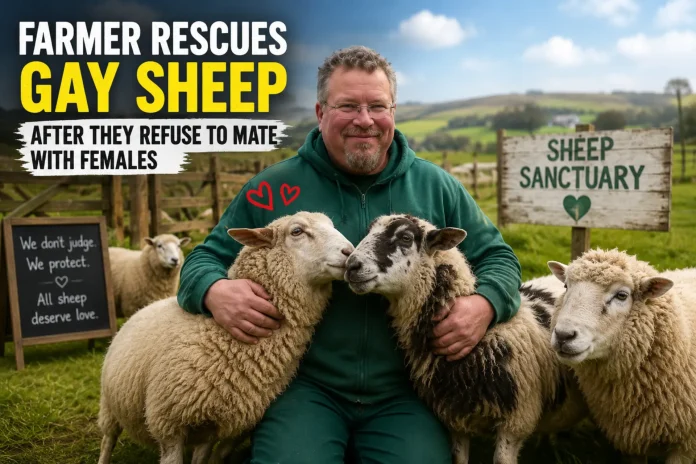
A German sheep farmer has built a sanctuary that rescues rams refusing to mate with females after a simple behavioral test confirms their preference for other males, sparing them from slaughter and turning their wool into support for broader causes.
Michael Stücke, a longtime sheep farmer in his early 50s who lives openly as a gay man on his property in Löhne, North Rhine-Westphalia, Germany, leads the effort. He operates a working farm of about 100 acres with more than 500 sheep overall. Stücke belongs to Germany’s gay farmers’ network and draws from his own experience in a traditionally conservative industry. Around 2021 he began discussing the common fate of non-breeding rams with a communications professional named Nadia Leytes, and the pair soon launched what became known as Rainbow Wool.
The project started in earnest when the first group of rescued rams arrived on the farm in September 2023. Breeders across Germany now contact Stücke when they identify rams that fail standard mating expectations. These animals are purchased, sometimes through competitive bidding that exceeds slaughterhouse prices, and transported to Löhne. There they join a dedicated group that currently includes roughly 35 male-oriented rams living alongside the rest of the flock. The sanctuary maintains a waiting list, and the project has drawn attention from animal behavior researchers and queer-rights advocates alike.
A dedicated group that currently includes roughly 35 male-oriented rams living alongside the rest of the flock. Confirmation that a ram prefers males happens through a straightforward pen test used by breeders and verified by the sanctuary. A candidate ram is placed with ewes during the breeding season while observers note his reactions. If he consistently ignores the females, shows no mounting behavior toward them, and instead directs attention or mounting attempts toward other males, he qualifies for rescue. This method separates true preference from simple dominance or general activity. Once accepted, the rams receive lifelong care on the farm without any pressure to breed.
Scientific research has established that same-sex behavior occurs naturally across the animal kingdom in more than 1,500 species. In domestic sheep specifically, studies show that approximately one in twelve rams, or roughly 8 to 10 percent, exhibit exclusive male orientation. These patterns appear innate rather than learned and have been documented through decades of ethological observation. Female sheep can also display same-sex preferences, though confirming them proves more difficult because mating roles differ between sexes.
Observations of homosexual behavior in animals stretch back through recorded history. Ancient writers in Greece and Rome noted same-sex mounting among various species, while modern systematic studies began gaining traction in the mid-20th century. One well-known modern example involved a pair of male penguins at New York’s Central Park Zoo in the early 2000s that formed a long-term bond and successfully incubated and raised a chick together. Roy and Silo, two chinstrap penguins, became a global symbol of same-sex pairing in animals after their keepers gave them an egg to incubate, which they successfully hatched. Similar consistent pairings appear in dolphins, bonobos, and many bird species, underscoring that such behavior forms part of normal biological variation rather than an anomaly.
Stücke’s approach addresses the economic reality of commercial sheep farming. Standard operations maintain roughly one ram for every 40 to 50 ewes and expect that ram to produce offspring during a short mating window. Rams that do not perform this role lose their commercial value and are typically sent to slaughter. By purchasing these animals and harvesting their wool instead, the sanctuary creates an alternative path that keeps the rams alive while generating resources for other purposes.
The wool from the rescued rams undergoes processing on the farm before being sent to mills, often in Spain. It is then turned into caps, patches, shoelaces, and larger knitwear items sold through the project’s channels. Proceeds support LSVD+, Germany’s largest queer rights organization, which funds initiatives in regions where such work faces legal challenges. Supporters can also sponsor individual rams directly, receiving certificates and helping cover feed and veterinary costs for the animals’ lifetimes.
This initiative demonstrates how targeted observation of animal behavior can intersect with practical farming decisions and wider social goals. By giving these rams a permanent home and channeling their wool into advocacy, the project reframes what might otherwise be viewed as economic loss into a sustainable model of care. It also highlights documented natural diversity in sexual behavior without requiring any alteration to core agricultural practices.
Recent expansions have brought additional visibility. A collection of knitwear made from the wool appeared on a New York runway in late 2025 through a collaboration involving designer Michael Schmidt and the dating app Grindr. The “I Wool Survive” runway show debuted at The Altman Building in Manhattan on November 13, 2025, featuring 36 pieces made from the sanctuary’s wool. The effort continues to draw interest from breeders seeking alternatives for rams that fail mating tests, and the sanctuary maintains a waiting list. Stücke and his partners emphasize transparency around the testing process and direct allocation of funds to established organizations.
Further information on the rams, current products, and sponsorship opportunities is available through the project’s official resources at rainbow-wool.com. The farm remains open to receiving additional qualified rams from German breeders who prefer this outcome over traditional culling. The work stands as a clear example of applying verified animal behavior data to create humane and productive alternatives in everyday agriculture.

