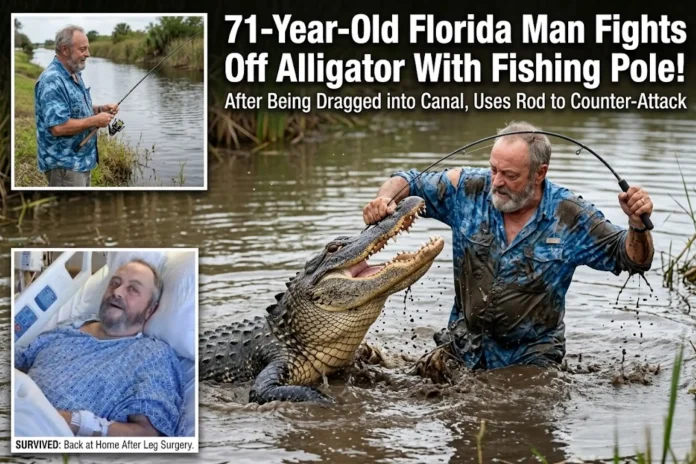
A 71-year-old Florida man named James Grayson McMicken survived a sudden alligator attack on June 26, 2026, by jabbing the reptile in the eyes with his thumb and fishing pole after it bit his right leg and dragged him into a canal behind his home in North Fort Myers. McMicken had stepped outside that evening with his female bulldog for a routine fishing session when the incident unfolded near his residence, described in some reports as located along or near West Lakeview Boulevard. The attack occurred as he made one cast into the water and began reeling in his line, turning an ordinary evening into a fight for survival.
McMicken, a longtime North Fort Myers resident with prior experience hunting alligators in Florida, knew to target the animal’s eyes as a vulnerable point based on that background. The alligator lunged from the canal, clamped down on his right leg, and rolled him off the bank into the water in an attempt to pull him under. He fought back by driving his thumb into one eye and repeatedly jabbing the other with the butt of his fishing pole until the alligator released its grip and swam away.
Once free, McMicken called his bulldog over for help. The dog stood still long enough for him to brace himself against her back, stand, and then hobble toward the house despite the pain from his injuries. Inside, his wife cleaned his wounds, but exhaustion caused him to pass out shortly afterward. Family members then rushed him to Cape Coral Hospital, where medical staff treated him for deep bite wounds on both sides of his right leg with staples and stitches.
The alligator escaped after McMicken fought it off and has not been confirmed captured. Florida Fish and Wildlife Conservation Commission trappers were actively searching for the animal in the days following the attack to remove it from the area as a precaution. No further details have emerged about any lasting harm to the alligator beyond the eye strikes that caused it to release its prey.
McMicken has since returned home and is recovering, beginning physical therapy to regain strength in his injured leg. He has voiced determination to remain in his home and continue his routines, declaring that no alligator would run him off. He also plans to take every precaution to stay safe going forward. Hospital staff expressed surprise at his survival story, with nurses stopping by to hear the details of how he escaped.
McMicken hopes to return to fishing soon but intends to approach the water’s edge more carefully, especially during evening or nighttime hours when visibility is lower. The incident took place in a canal directly behind his home, a common setting in North Fort Myers where alligators frequently inhabit local waterways. His experience highlights how prior knowledge of animal behavior, combined with decisive action, can turn a life-threatening encounter into a story of survival and recovery, much like other remarkable wilderness survival stories that have made headlines.
Residents living near Florida canals and ponds face ongoing risks from native alligators that occasionally view humans or pets as potential prey in close proximity to water. McMicken’s case joins a recent string of wild animal encounters that have put owners and their pets in harm’s way. The Florida Fish and Wildlife Conservation Commission offers practical guidance on safely coexisting with alligators, including advice to keep pets leashed and away from the water’s edge and to avoid feeding or approaching the animals.
His story also illustrates the resilience many older adults demonstrate when faced with sudden physical challenges, drawing on life experience to respond effectively under pressure. Communities in alligator-prone regions can learn from such events by reviewing official safety resources and maintaining awareness, without unnecessary fear of the wildlife that shares their environment. McMicken’s positive outlook during recovery reinforces the value of mental focus alongside physical treatment in overcoming trauma from wildlife encounters.