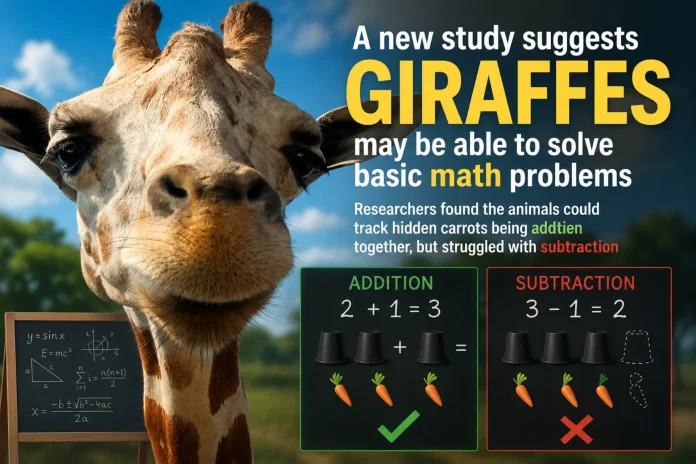
Researchers have discovered that giraffes can mentally combine quantities of carrots they cannot see in a process akin to basic addition, succeeding at rates significantly above chance while failing to show similar skill when the quantities are subtracted instead. The peer-reviewed study, led by Iker Loidi from the University of Barcelona and published on June 26, 2026 in the journal Scientific Reports (an open-access mega-journal from Nature Portfolio that publishes rigorously reviewed research across the natural sciences), tested this capacity for the first time in the species using four giraffes at the Barcelona Zoo. The finding joins a recent wave of surprising animal cognition cases, including a rescued octopus that learned to play piano blues, as reported on this site.
The experiment used a straightforward apparatus consisting of two yellow containers set about fifty centimeters apart on a table, along with a central green container. Researchers first showed the giraffes different numbers of carrot pieces roughly four centimeters long in the yellow containers, allowing them to view the amounts for about five seconds before closing the lids. For the addition-style trials, they then displayed extra carrots in the green container and transferred one to three of them into one of the covered yellow containers while the giraffe watched the action, but could not see the updated totals inside.
The giraffes decided by approaching the table and touching or sniffing one of the yellow containers with their muzzles, selecting the one they expected to contain the greater total. To ensure the choices reflected mental calculation rather than visible cues, the team included control trials where quantities remained visible or were closed after showing. They also tested a subtraction version where carrots were removed from one container into the empty green one, and a transfer version where items moved from one yellow container to the other.
All four giraffes performed above chance in the addition-style trials, reaching an overall success rate of about sixty-eight percent. Performance dropped to chance levels in the subtraction and transfer conditions. Notably, the fifteen-year-old female Nuru and the seven-year-old male Njano continued succeeding at high rates even in trials designed to prevent reliance on the simple strategy of choosing the container last manipulated by the experimenter, while the eight-year-old male Nakuru and twenty-one-year-old female Yalinga relied more on that cue.
This research extends earlier findings from the same research group showing that these giraffes already use statistical reasoning to pick better food options in similar setups, as detailed in work published in 2023. Giraffes, as members of the hoofed ungulate group, face ecological pressures from scattered food sources like acacia trees and fluid social structures that may favor abilities to track and update quantities mentally. The study highlights how such skills could represent foundational elements for more complex numerical thinking across different animal lines, in patterns that even shape viral animal personalities featured in everyday media coverage.
These results broaden perspectives on animal intelligence by demonstrating that sophisticated mental tracking does not require exceptionally large brains relative to body size. The giraffes demonstrated reliable updating of hidden quantities up to totals of five carrots, suggesting practical value in their natural habitat for optimizing foraging amid patchy resources. Individual differences among the tested animals mirror patterns seen in humans and other species, underscoring that cognitive abilities vary within groups rather than following a uniform species-wide profile. Such insights encourage continued exploration of cognition in underrepresented mammals, much as recent rediscovery efforts have uncovered long-lost mammal species thought extinct for millennia, and are further outlined in the University of Barcelona research announcement.