

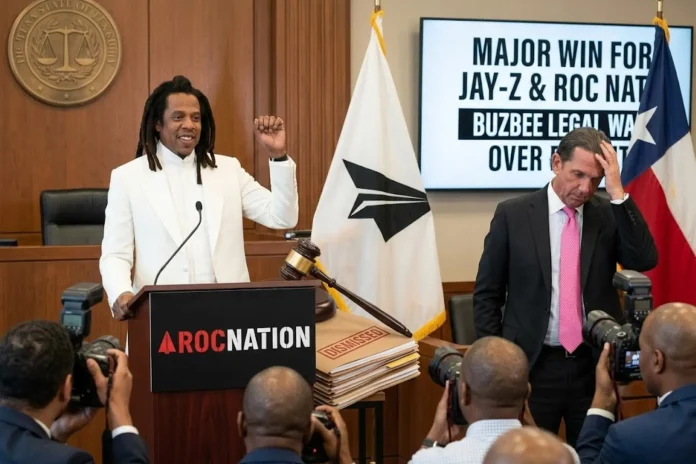
A Texas judge has dismissed all claims against Jay-Z’s Roc Nation in two lawsuits filed by former clients of Houston attorney Tony Buzbee, ruling that the court lacked personal jurisdiction over the New York-based company and delivering a significant procedural victory in a long-running legal feud.
The ruling, issued in Harris County District Court in Houston, Texas, around mid-June 2026, removes Roc Nation from cases brought by former Buzbee clients Gerardo Garcia and Jose Maldonado as well as the Buzbee Law Firm itself. The suits alleged that Roc Nation and associated parties conspired to recruit former Buzbee clients to file claims against the law firm using improper tactics such as cash offers and impersonation of state officials. HipHopWired confirmed that Judge Kristen Hawkins dismissed the lawsuits on jurisdictional grounds.
This development stems from a chain of events that began in late 2024. Following high-profile allegations tied to the ongoing federal trial of Sean Combs, in which Buzbee represented clients who named Jay-Z, Buzbee filed the Texas actions in December 2024 in Harris County. The filings claimed Roc Nation and its legal team, including attorneys from Quinn Emanuel Urquhart & Sullivan and Mississippi-based lawyer Marcy Bryan Croft, engaged in a scheme to damage Buzbee’s practice by soliciting clients to sue him.
The underlying tensions trace back further. In late 2024, a Jane Doe plaintiff filed a lawsuit alleging sexual assault by Jay-Z and Combs at a 2000 event. Variety reported that the plaintiff voluntarily dismissed that case with prejudice in February 2025. Law.com documented how Jay-Z then filed his own claims against Buzbee in California, accusing the attorney of extortion and defamation, only to see those claims dismissed in July 2025 on anti-SLAPP grounds. That ruling meant the court found Buzbee’s statements protected under the First Amendment.
In the Texas proceedings, defendants including Roc Nation filed motions to dismiss. Judge Kristen Hawkins ruled that Roc Nation, headquartered in New York, did not have sufficient minimum contacts with Texas to allow the state court to exercise personal jurisdiction over it for these specific claims. The court did not reach the merits of the allegations about client solicitation. Separate anti-SLAPP rulings also dismissed claims against Croft, her firm, and Quinn Emanuel with prejudice, potentially allowing those parties to seek attorney fees.
Why the lawsuits were filed in the first place centers on retaliation and business interference, according to the complaints. Buzbee’s side argued that after the Jane Doe allegations surfaced, Roc Nation and its representatives allegedly used “shadowy operatives” to approach former clients with promises of money, in some cases reportedly up to $10,000, to encourage them to sue Buzbee’s firm for alleged past misconduct. Garcia and Maldonado claimed they were approached at their homes by individuals claiming to represent “the state.” Roc Nation has consistently described the Texas suits as “baloney” and “a sham” intended to distract from other matters.
How the cases progressed involved standard but aggressive motion practice. After the December 2024 filings, defendants removed some actions to federal court before they were remanded back to state court. Extensive briefing on jurisdiction and anti-SLAPP protections followed, culminating in the June 2026 rulings. The dismissals against Roc Nation mean the company will not have to defend the substance of the claims in Texas courts at this stage.
What changed the outcome was the court’s strict application of personal jurisdiction rules. Under U.S. Supreme Court precedents, a company must have purposeful contacts with a state for that state’s courts to hale it into litigation. Roc Nation successfully argued it lacked those connections for these particular disputes. This procedural focus allowed Roc Nation to exit the Texas cases without a ruling on whether any improper client recruitment actually occurred.
The broader feud shows no signs of complete resolution. Plaintiffs could attempt to refile the claims against Roc Nation in New York or another jurisdiction with stronger ties. Meanwhile, the hip-hop mogul has referenced the dismissed Jane Doe case in public statements and music, expressing relief that his grandmother lived to see its conclusion. Court records also reference Jay-Z pursuing additional amended claims tied to alleged misconduct during the original litigation.
These developments highlight the complex, multi-state nature of legal battles involving high-profile entertainers and their business entities. Jurisdictional victories like this one can significantly alter the cost, timeline, and venue of disputes even when the underlying allegations remain untested in court. For Roc Nation and Jay-Z, the Texas ruling removes one front in the conflict while reinforcing the importance of where such cases are litigated.
Public interest in the matter remains high due to the celebrity names involved and the serious nature of the original allegations. Both sides have used court filings and statements to shape the narrative, with Buzbee positioning his work as fighting for accountability and Jay-Z’s camp framing the Texas suits as baseless distractions.
Additional context drawn from public court records in Harris County, Texas, and related proceedings. Harris County court information is available through the Harris County District Courts portal.

