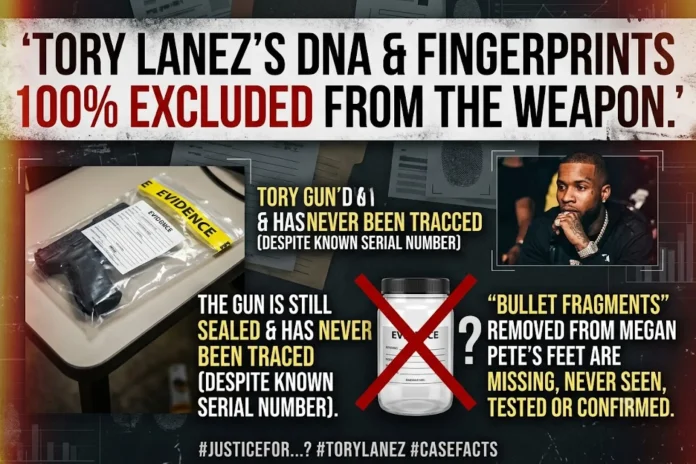
Claims that DNA and fingerprint analysis fully excluded Tory Lanez from the gun used in the 2020 shooting of Megan Thee Stallion have gained fresh momentum, with a U.S. representative publicly calling for an emergency review and potential pardon from California Governor Gavin Newsom.
The assertions also question the current status of the firearm and the bullet fragments removed from the rapper’s feet. They have circulated widely on social media and were highlighted in recent public comments by elected officials who say they reviewed supporting materials.
The case began on July 15, 2020, when an argument erupted inside an SUV outside a late-night gathering at Kylie Jenner’s Hollywood Hills home. Shots were fired, and Megan Thee Stallion sustained gunshot wounds to both feet. Lanez was arrested shortly afterward after police found a firearm in the vehicle. He has consistently maintained his innocence since that night.
At trial in late 2022, prosecutors relied heavily on testimony from Megan Thee Stallion and her then-close friend Kelsey Harris, who was also in the vehicle. Jurors heard accounts of the confrontation and the moments when the shots were fired. Forensic evidence, including DNA recovered from the gun, was presented by experts on both sides.
Trial records show the DNA on the firearm came from at least four individuals. The dominant male contributor did not match Lanez. Smaller contributions left analysts unable to include or exclude him as a source on the gun itself, though he was excluded from DNA found on the magazine. Lanez’s legal team has long argued these results, combined with other factors, should have created reasonable doubt.
Despite these points raised during and after the trial, Lanez was convicted on December 23, 2022, of assault with a semiautomatic firearm, carrying a loaded unregistered firearm, and negligent discharge of a firearm. He was sentenced to 10 years in state prison in August 2023. The jury’s decision rested primarily on the eyewitness testimony, which appellate courts have continued to view as sufficient to sustain the verdict.
Recent public statements have revived questions about the handling of physical evidence. Supporters and some advocates claim Lanez’s DNA and fingerprints were fully excluded from the weapon, that the gun remains sealed and was never traced despite law enforcement knowing its serial number, and that bullet fragments removed from Megan Thee Stallion’s feet were never properly seen, tested, or confirmed in court. Kelsey’s former bodyguard has also come forward, claiming that Harris, not Lanez, was the shooter.
Court filings and state responses to appeals have stated that the Los Angeles Police Department maintains custody of the firearm, magazine, casings, and bullet fragments. Appellate records confirm the items were booked into evidence and remain available. These responses directly addressed earlier claims that key evidence had gone missing or become inaccessible.
U.S. Representative Anna Paulina Luna has become one of the most visible voices renewing scrutiny of the case. In recent comments, she said the matter was first brought to her attention by Amber Rose. After reviewing materials in her office, Luna stated that four people’s DNA were found on the firearm, none of which belonged to Lanez, and that there were zero fingerprints on the magazine. She described the statistical chance of Lanez’s DNA being present as extremely low and pointed to ring camera footage she believes disproves key elements of the prosecution’s narrative, including the testimony that Lanez ordered Megan to dance before shooting at her feet.
Luna also criticized what she called the submission of Lanez’s rap lyrics as evidence during the proceedings, calling the practice egregious. She said she has reached out to Governor Newsom’s office requesting an emergency meeting and is working with members of the California congressional delegation. Luna emphasized that she takes domestic violence allegations seriously but believes the evidence she reviewed supports Lanez’s innocence and that the case was driven more by headlines than by a full accounting of the facts.
She further noted that Hollywood and politics often overlap in high-profile matters and suggested examining the background of the original prosecutor. Luna said she has spoken directly with Lanez, who told her he was attacked in prison during a stabbing incident and that, if released, he intends to focus on prison reform efforts.
Multiple appeals and habeas petitions filed by Lanez’s legal team have been denied by California courts. Judges have ruled that the original trial evidence, particularly the eyewitness testimony, was sufficient and that claims regarding evidence preservation or access did not meet the legal threshold for overturning the conviction. Detailed examinations of the trial record show the DNA findings were presented and debated by experts from both sides.
The persistence of these claims, even after appellate review, stems in part from differing interpretations of the same forensic data that was already before the jury and subsequent courts. While supporters view the mixed DNA results and other details as exonerating, the judicial system has consistently prioritized the direct testimony of those present during the incident. Habeas challenges focused on the gun and bullet fragments were rejected after the state confirmed the evidence remained in official custody.
Tory Lanez supporters have also pointed to media coverage and alleged outside influence, including connections to Jay-Z’s Roc Nation, as reasons the case has not received what they consider fair re-examination. These perspectives continue to circulate alongside the forensic arguments.
The case underscores the challenges that arise when high-profile criminal matters attract sustained public and political attention long after verdicts are rendered. Elected officials invoking oversight authority can bring additional visibility to lingering questions, yet the finality of jury decisions and appellate rulings remains a core feature of the justice system.
As of June 2026, Lanez continues to serve his sentence. The combination of eyewitness accounts, the original forensic presentation, and the outcomes of legal challenges has kept the conviction in place despite ongoing advocacy and reinterpretations of the evidence.
Primary court documents and trial records remain the most direct sources for understanding how the case reached its current point. Those seeking the full context can review the original proceedings and appellate decisions for themselves.