

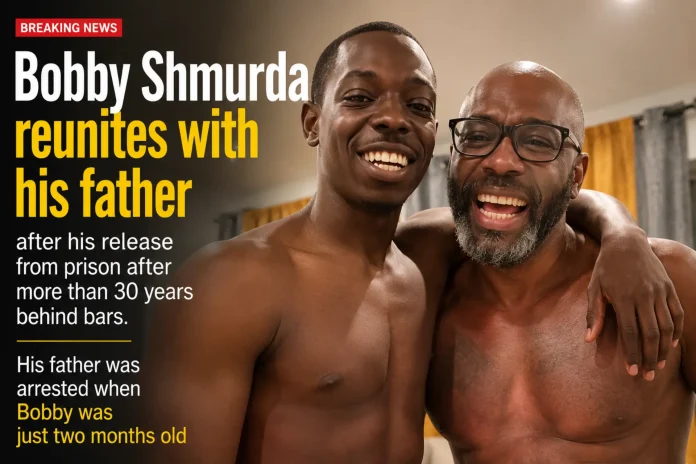
Rapper Bobby Shmurda experienced a long-awaited reunion with his father Gervase Johnson after more than 31 years of separation that began when authorities arrested Johnson in Florida shortly after the artist’s birth. The emotional meeting, captured in video footage now circulating widely on social platforms, shows clear excitement as both men smile broadly, laugh together, and share a relaxed connection in a casual indoor and vehicle setting. Johnson had served over three decades behind bars following his 1995 conviction in Miami-Dade County on charges that included attempted murder, with reports and the rapper’s own accounts describing elements tied to robbery and assault that carried a sentence equivalent to around 120 years.
The long disconnection took root when Johnson was taken into custody when Pollard was only two months old, forcing his mother Leslie Pollard to move the family from Miami to East Flatbush in Brooklyn. Born Ackquille Jean Pollard on August 4, 1994, the future rapper grew up with limited direct contact with his father, relying instead on occasional prison visits and phone calls during his childhood and teenage years. This early absence shaped much of Pollard’s upbringing in a single-parent household while he navigated the streets and music scene of Brooklyn.
Pollard rose to fame in 2014 with his breakout single “Hot Nigga,” which introduced the signature Shmoney Dance and led to a recording deal with Epic Records. His career quickly intertwined with his role in the GS9 crew, bringing both widespread popularity in hip-hop circles and legal challenges that resulted in his own arrest on December 17, 2014, at Quad Studios in New York alongside 12 other GS9 members on conspiracy and weapons charges. He pleaded guilty in 2016, received a seven-year sentence, and served roughly six years before gaining release from Clinton Correctional Facility on February 23, 2021. His parole supervision officially ended in February 2026, giving him full freedom for the first time in over a decade.
The recent video of the father-son reunion highlights genuine excitement through visible laughter, broad smiles, and easy body language as Pollard films the moment and Johnson holds a stack of cash while appearing comfortable and joyful. The footage moves between an indoor room with bright lighting and curtains and a nighttime vehicle interior, capturing the pair shirtless and relaxed in what feels like an unscripted celebration of freedom and reconnection. Johnson’s release from Florida custody after more than 30 years created the opportunity for this direct meeting, allowing the family to bridge a gap that spanned most of Pollard’s life.
This reunion underscores the profound personal impacts of extended prison sentences on families, particularly in communities where such experiences often affect multiple generations. For Pollard, who himself navigated time behind bars before returning to music and public life with new releases and performances, the moment represents a significant step toward personal closure after years of limited contact. The visible joy in the shared footage offers a positive human element, yet it also draws attention to the years of missed milestones and the practical adjustments both men now face during reintegration.
Public response to the circulating video has been largely warm, with many noting the emotional weight of reconnecting after such a long separation and the rare chance for father and son to build new memories together. While the event centers on this private family milestone, it naturally brings focus to the lasting effects of lengthy incarceration and the resilience required to move forward. Details of Pollard’s background and career milestones are documented in established biographical records, while information surrounding the original conviction appears in Florida court documentation. His recent activities, including a tour that faced cancellation amid ticket sales controversy, continue to draw public attention as he rebuilds his career on his own terms.

