

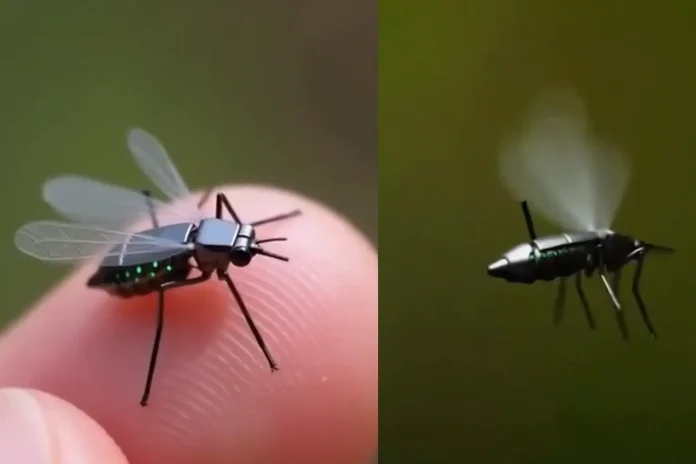
A viral video shared by NEXTA on X has millions buzzing: a tiny metallic drone, no bigger than a mosquito, perches on a person’s fingertip. It suddenly takes off with transparent wings buzzing and glowing green lights flashing in cinematic slow-motion shots. The clip looks like something ripped from a sci-fi thriller. But is this real Chinese military tech or just another slick AI-generated illusion making the rounds online?
The story has legs because parts of it are very real. In June 2025, China’s National University of Defense Technology (NUDT) in Hunan province showcased a genuine mosquito-sized microdrone on state broadcaster CCTV-7. As researcher Liang Hexiang held the small device in his hands, he explained to the audience:
“In my hand, I have a little robot that looks like a mosquito. Small bionic robots such as this can be particularly useful for gathering information in battle.”
Official footage and reporting confirm a prototype roughly 1–2 centimeters long weighing under 0.3 grams (some reports say even lighter, around 0.2 grams). It features a slender body, leaf-like flapping wings, and hair-thin legs designed to mimic a real insect. Reports mention wings capable of high-frequency flapping and the ability to carry miniature sensors for basic reconnaissance.
That flashy NEXTA video making rounds? Shiny surfaces, bright glows, smooth flying bits it feels futuristic. Yet the model flashed on China’s official broadcasts looks far less fancy. Some experts say the popular edits likely came from computer tricks, artificial imagery, or digital tweaks. Reports about stealthy solo missions, crossing continents without help, or entire fleets operating quietly haven’t been backed by visible proof.
The U.S. is watching closely. America’s own research into micro-drones, including Harvard’s RoboBee and MIT projects, shows this is a global race in military robotics and AI. Tiny drones could change urban warfare, indoor surveillance, and espionage which explains why national security experts are paying attention amid U.S.-China tech competition.
Reality fades when excitement takes over. Minutes pass before power runs out, that is how brief the flying time stays. A gust from any source, maybe just indoor cooling, throws it off track. Carrying anything beyond tiny gear like simple recorders or lenses feels impossible right now, especially outside. Reports about actual battlefield use or groups working together? None have been proven so far.
Surprising what happens when engineers copy nature NUDT’s team just proved that. Yet somehow, every solid step forward becomes louder than it should be across social media. Instead of chasing flashy claims, maybe look at what’s been tested; truth holds weight even without extras. While tiny drones evolve in labs everywhere, questions grow too not just about what they can do, but whether we’re ready for them watching silently.

