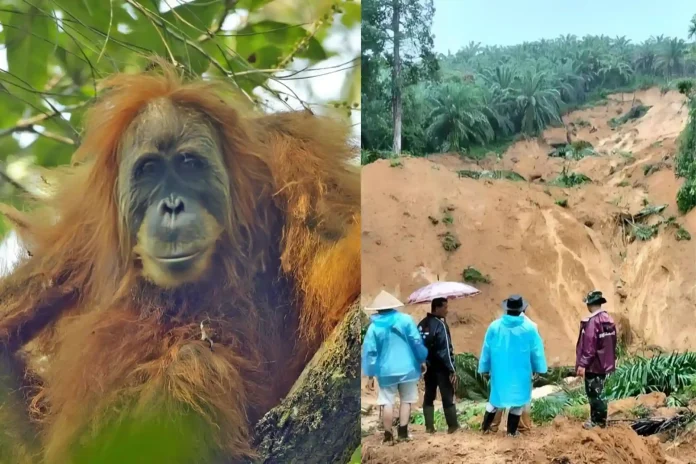
In late November 2025, four days of relentless rain from Cyclone Senyar triggered landslides and flooding that claimed the lives of at least 58 Tapanuli orangutans roughly 7% of the entire remaining global population of this critically endangered great ape.
Out here, where life hangs by a thread, another absence weighs heavy. When numbers dip below eight hundred in nature, each ending tips the balance further. Survival stretches thinner with every one gone.
Only in 2017 did scientists name the Tapanuli orangutan (Pongo tapanuliensis), setting it apart as the most recently identified great ape and also the least numerous. Living nowhere else but the forest patches of Batang Toru in North Sumatra, Indonesia, they spend their lives among branches, never touching ground. Because females bear young just once in many years, population drops hit hard bounce-backs take time. Though quiet and scattered, each group holds vital clues to survival against shrinking habitats.
Heavy rains hit northern Sumatra during the last days of November 2025. Over a thousand millimeters fell in just hours because of Cyclone Senyar. Water poured down slopes until earth began moving too. Whole hillsides shifted where about five hundred to nearly six hundred orangutans live. This area, called the West Block of Batang Toru, saw destruction sweep through fast. Muddy rivers of soil buried trees and blocked paths animals used. Rain did not stop long enough for ground to hold still.
Researchers used satellite imagery from Sentinel-2 and PlanetScope to map 8,303 hectares (±1,760 ha) of landslide scars and flood damage. Overlaying this with orangutan density estimates, they calculated that about 11% of the local West Block population was likely killed. That translates to at least 58 individuals globally approximately 7% of the species.
“The figure is conservative,” noted lead author Erik Meijaard of Borneo Futures.
“It does not fully account for indirect deaths from canopy damage, food shortages, injuries, or stress.”
One confirmed carcass was recovered in debris near Pulo Pakkat village.
A peer-reviewed study published June 10, 2026, in Current Biology detailed the findings. The event, described by experts as a “devastating demographic shock,” also devastated roughly 11.7% of forest cover in the key habitat area.
“Such losses are unsustainable,” Prof. Serge Wich from Liverpool John Moores University and Prof. Jatna Supriatna from Universitas Indonesia warned of the dire consequences. The species already faces pressure from habitat fragmentation, with only about 2.5% of its original habitat remaining intact.
Landslides grew worse because forests vanished mining, vast palm oil fields, alongside big dams weakened the ground. WALHI, part of a wider green network, called out these changes as harmful shifts in nature’s balance. Faced with mounting pressure, officials pulled licenses from 28 firms tied to roughly 1 million hectares of land. Among them stood the Martabe gold site run by PT Agincourt Resources, plus the hydro effort on the Batang Toru river led by another firm. Legal steps followed. Six businesses now face court over harm done to ecosystems, claims seeking close to $283.8 million in costs.
One wrong turn might be enough to tip Tapanuli orangutans into irreversible decline, experts say. A sudden drop of 7 percent on top of steady dangers and worsening storms fueled by shifting climates – tightens the squeeze fast.
Scientists are calling for an immediate moratorium on habitat-degrading activities, expanded protected areas, and increased international funding. A small newly documented group outside the main ecosystem offers a sliver of hope, but recovery remains uncertain.
For a species known to science for less than a decade, this disaster underscores how quickly one of Earth’s most unique primates could slip away. Global attention and concrete action may determine whether the Tapanuli orangutan survives the coming years.