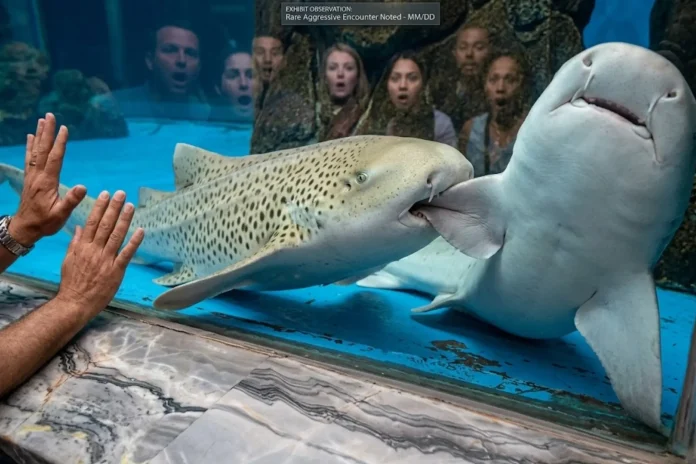
Aquarium visitors recoiled in alarm when one leopard shark appeared to attack another by latching onto its pectoral fin inside a public tank.
Staff quickly clarified the moment as standard courtship behavior rather than violence. Males of the species use their mouths to grip females during mating to maintain position and enable successful copulation. The brief clip captured the pair maneuvering together in clear tank water, prompting gasps from onlookers who interpreted the action as harmful.
The behavior plays out when a male approaches a female and secures a hold on her pectoral fin or nearby body area. This grip allows alignment for the male to insert one of his claspers and transfer sperm internally. Females have evolved noticeably thicker skin in these regions precisely to withstand such contact without serious injury. In the viral footage, the interaction looks intense yet results in no visible blood or fin damage, consistent with documented patterns across multiple shark species. The aquarium team explained the scene directly to ease visitor concern, turning potential panic into an educational opportunity about marine reproductive strategies.
Such fin gripping occurs in both wild and captive settings, though it rarely draws public attention outside short social media clips. Recent scientific observations of Indo-Pacific leopard sharks (also known as zebra sharks) recorded two males holding a single female’s fins before taking turns mating with her in a calm sequence that lasted roughly 110 seconds. Marine biologist Dr. Hugo Lassauce documented the event off New Caledonia, providing the first wild footage of mating in this endangered species and revealing cooperative rather than purely aggressive dynamics.
“I came across these two males grabbing the female’s pectoral fins with their mouth.”
The online spread of the aquarium video triggered waves of humorous commentary as people drew parallels to human dating mishaps. Viewers joked that the male’s approach resembled awkward flirting that would not fly on land. Others expressed relief upon learning the truth, celebrating the clip for revealing nature’s unexpected courtship rituals without actual harm. The fascination underscores a broader public interest in animal behaviors that challenge assumptions about aggression in the ocean.
This incident serves as a reminder that what appears brutal in the underwater world often represents sophisticated adaptation rather than conflict. Leopard sharks and their relatives rely on these physical cues because they lack limbs for gentler contact, making the mouth a practical tool for reproduction. Aquariums play a vital role in bridging that knowledge gap for everyday visitors, transforming startling moments into chances for deeper appreciation of marine life. As more such videos circulate, they encourage viewers to pause before judging animal actions through a purely human lens and to support conservation efforts that protect these species in their natural habitats.
For further reading on shark reproductive biology, explore resources from institutions studying elasmobranch mating. Details on the recent wild observation appear in reports from the University of the Sunshine Coast collaboration with researchers in New Caledonia. Additional context on the behavior is available through National Geographic’s coverage of the groundbreaking mating footage. Aquariums maintaining leopard shark exhibits continue to share similar educational content to demystify these encounters.
Meanwhile, the entertainment world continues to deliver its own share of surprising moments. From Rubi Rose opening up about her OnlyFans earnings to high-profile discussions around celebrity roles and public perception, viral stories often blur the line between shock and education—just like this leopard shark encounter.