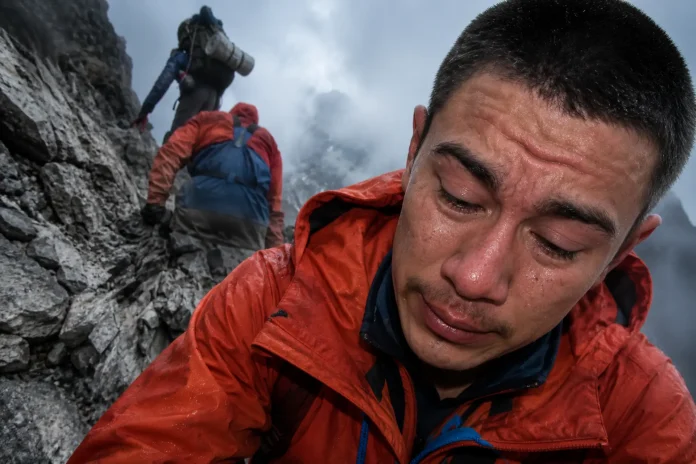
On May 20, 2026, at 8:16 a.m. local time in Nepal, the 34-year-old climber stood atop the 8,848.86-meter peak. He carried a simple plaque that captured the heart of his journey: “To those who thought that life ended after the fall. Rustam Nabiev, Everest 2026.” Nabiev dedicated the historic ascent to everyone following his story, reaching the summit in a country whose national calendar was already 56 years ahead of the Western one. His message rang clear and powerful: as long as there is life in you, fight to the end because it is worth it.
In July 2015, while serving in the Russian Airborne Forces, Nabiev was sleeping in his barracks in Omsk when the building collapsed. The disaster killed around two dozen fellow soldiers, a toll confirmed by contemporaneous Defense News coverage of the barracks collapse. Nabiev spent hours trapped under rubble. He endured two clinical deaths, required 16 surgeries, and ultimately lost both legs below the waist. That tragedy could have defined the end of his active life. Instead, it became the starting point for an extraordinary second chapter. His wife Indira stood by him from the earliest days of recovery. She helped pull him through the darkest moments and became his deepest source of strength.
Nabiev rebuilt himself through adaptive sports, including sledge hockey with a Moscow club. He turned to mountaineering as a way to reclaim purpose and prove that limits exist mostly in the mind. Before Everest, he had already made history by becoming the first double amputee to summit Manaslu at 8,163 meters without prosthetics in 2021. He also conquered peaks such as Elbrus, Kilimanjaro, and Mera Peak. For Everest, he joined an expedition with Seven Summits Club. Five experienced Sherpas supported him throughout. Two stayed close at all times while another monitored his oxygen levels.
He moved upward by pulling his body with ice axes and raw upper body power. Videos from the climb show him gripping metal ladders across the dangerous Khumbu Icefall. That section alone demanded nearly 15 hours of intense effort to reach Camp I at around 6,065 meters. The push from Camp 3 to Camp 4 took him more than 14 hours. Every single meter required total concentration. Descent proved even tougher. Without legs for natural balance, he had to hold himself back constantly on ice and rock to avoid slipping. The physical and mental strain tested him at every step.
Family fueled Nabiev more than any summit photo or record. His wife Indira and their two daughters, eight-year-old Sofia and an eleven-month-old baby girl, waited in Russia. Sofia drew pictures and wrote letters that he carried with him. One note simply declared that her papa would conquer Everest with the strength of his two arms. Those words kept him going through exhaustion and doubt. Nabiev has said his climbs are not only for people with disabilities but for anyone facing hardship. He believes everyone encounters moments when life knocks them down. The choice to rise again matters most.
This achievement stands out in the long history of Everest expeditions. Other double amputees have summited with prosthetics, yet Nabiev chose to rely solely on his arms and core strength, becoming the first climber to reach the summit of Everest without prosthetics, as documented by the Kathmandu Post’s coverage of the historic ascent. His approach adds a new dimension to what adaptive mountaineering can mean. It challenges assumptions about capability and highlights the incredible resilience of the human spirit. Sherpas, fellow climbers, and observers worldwide described the feat as a powerful example of willpower overcoming physical boundaries.
Nabiev plans to continue toward the Seven Summits, the highest peaks on each continent. He has a few major goals remaining, including those in North America and Australia. His journey reminds readers that personal mountains come in many forms, an idea echoed by a recent California wilderness survival story that captured similar public attention. Some stand tall in the Himalayas while others exist in daily struggles. Nabiev has shown that with determination, support from loved ones, and refusal to quit, those peaks can still be reached.