

A 30-Year Study Documents Rare Chimpanzee Split Sparking Deadly Conflict in Uganda
A long-term study has documented the permanent split of a large chimpanzee community in Uganda, leading to sustained lethal attacks between former group members.
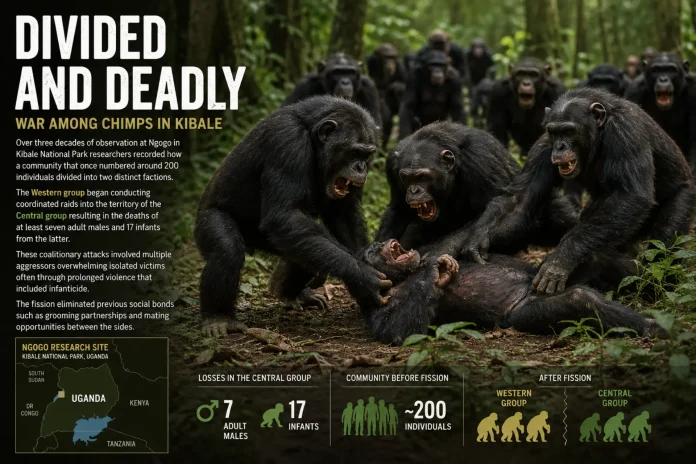
Over three decades of observation at Ngogo in Kibale National Park, researchers recorded how a community that once numbered around 200 individuals divided into two distinct factions. The Western group began conducting coordinated raids into the territory of the Central group, resulting in the deaths of at least seven adult males and 17 infants from the latter. These coalitionary attacks involved multiple aggressors overwhelming isolated victims, often through prolonged violence that included infanticide. The fission eliminated previous social bonds such as grooming partnerships and mating opportunities between the sides.
Social network analysis using 24 years of detailed behavioral data revealed a sharp transition in 2015. Researchers applied community detection algorithms such as the Leiden method to grooming associations, travel parties, and other interactions. What had been a fluid, cohesive network with bridge males connecting clusters polarized rapidly after the loss of key connectors around 2014 and a 2017 respiratory epidemic that killed about 25 individuals. By 2018 the groups occupied separate territories with no further mixing. Network metrics showed increased modularity and decreased connectivity across the emerging divide, turning former allies into outgroup targets.
This Ngogo event echoes the famous Gombe Chimpanzee War observed by Jane Goodall in Tanzania during the 1970s. In Gombe, a community split into the larger Kasakela and smaller Kahama factions around 1971. Over four years, from 1974 to 1978, Kasakela males systematically eliminated all Kahama adult males through coordinated ambushes and beatings. At least six Kahama males were killed, with others missing and presumed dead. Females were sometimes beaten and absorbed into the victorious group.
Key facts about the Gombe war include its documentation through direct observation of brutal attacks such as the prolonged beating death of the male Godi, and reports of cannibalism. The war fundamentally shifted scientific views of chimpanzees from peaceful vegetarians to creatures capable of calculated lethal coalitionary violence. Ngogo provides cleaner evidence because the population was never provisioned, and occurred on a much larger scale.
The relational dynamics hypothesis gains strong support from these cases. Shifts in social networks and the loss of bridging individuals appear sufficient to fracture groups and enable sustained enmity. In both Ngogo and Gombe, former friends became enemies once new group identities solidified. This offers insights into the evolutionary roots of human tribalism and conflict.
The findings highlight the fragility of even large primate societies with strong kinship. Full details of the social network methods and attack records appear in the peer-reviewed study published in Science. Additional project information is available through the Ngogo Chimpanzee Project.

