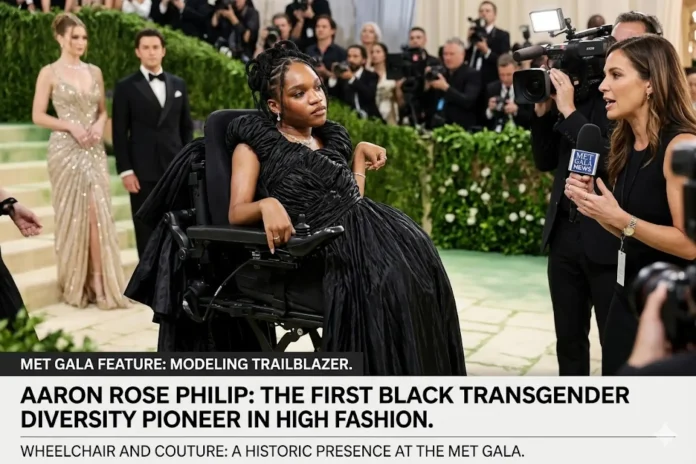
Aaron Rose Philip, recognized as the first Black transgender woman with quadriplegic cerebral palsy signed to a major modeling agency, attended the 2026 Met Gala at the Metropolitan Museum of Art in New York City.
The model arrived on the red carpet in a motorized wheelchair wearing a custom black gown from Collina Strada. Coverage positioned her presence as a milestone for visibility in fashion. Philip has maintained a modeling career since signing with Elite Model Management in 2018. Her attendance at the high profile event continues decades long discussions about who belongs in elite creative spaces.
Philip was born in Antigua and Barbuda in 2001 and relocated to the Bronx early in life to gain improved access to healthcare and education for her condition. She published the memoir This Kid Can Fly: It’s About Ability (NOT Disability) at age 14. Subsequent runway work for Moschino, campaigns with Sephora and Dove, and features in British Vogue built her professional record. Philip has collaborated with Naomi Campbell and used her platform for disability advocacy.
Her participation raises valid ethical questions about representation in fashion. On one side, the visibility offers genuine good by demonstrating capability and presence for people with complex disabilities in spaces long closed to them. It can inspire families and individuals facing similar physical challenges and push designers toward practical adaptations like accessible runways or adaptive garments. Philip’s documented persistence over years, including early public writing and consistent bookings, supports the view of personal agency rather than pure tokenism.
Critics counter that stacking multiple identity categories for maximum narrative impact risks reducing a person to a checklist for institutional virtue signaling. Questions linger about whether the fashion industry provides sustained career support beyond symbolic moments or simply exploits rare combinations for attention and social credit. With quadriplegic cerebral palsy involving significant motor limitations and spasticity, some observers worry about physical and emotional strain from navigating such events, even with assistance. Public reactions split sharply, with praise for inclusion alongside accusations of performative exploitation that may not translate to broader industry change for disabled people overall.
Fashion has shifted toward wider casting in recent seasons, yet core challenges remain in adapting shows, campaigns, and events for full participation. Philip’s trajectory reflects both individual resilience and the limits of optics driven progress. True advancement would require measurable gains in employment, training, and accessibility rather than singular red carpet appearances. The Met Gala itself faces ongoing scrutiny for elitism and sponsorship choices that prioritize spectacle over substance.
Balanced evaluation suggests her story contains elements worth celebrating alongside aspects warranting caution. Supporters see expanded opportunity and challenge to narrow standards. Skeptics highlight potential commodification of identity that distracts from practical support needs for disabled communities. Philip continues building a multifaceted career as model, author, and advocate.