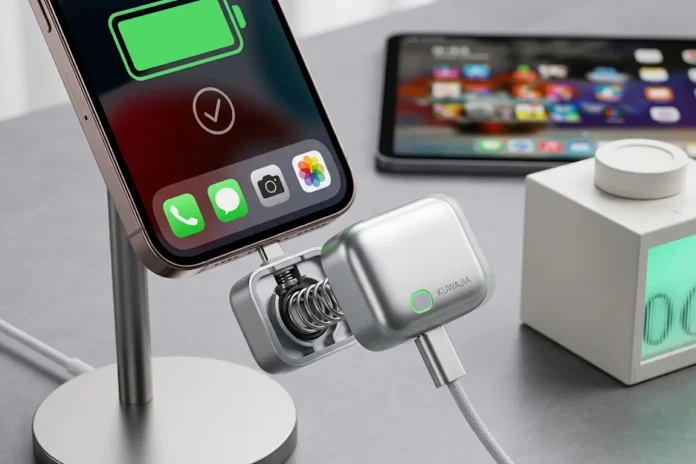
A Chinese company has created a charger adapter that physically ejects from a smartphone the instant the battery reaches full capacity. Kuwajia designed the compact accessory with artificial intelligence to monitor voltage and current levels before activating a spring-loaded mechanism and electromagnet for total disconnection. This hardware solution promises to eliminate any continued power flow that software alone might allow. Everyday users who worry about gradual battery wear now have a hands-off option that requires no apps or device modifications.
The adapter simply plugs between a standard cable and the phone where it supports charging speeds up to 140 watts across both Android and iOS models. Once the battery hits 100 percent the built-in sensors trigger the gentle pop out motion in less than a second to halt all electricity. Demonstration videos show the process unfolding on a basic desk setup with clear views of battery health metrics that highlight potential long term gains. Owners can walk away confident that the connection ends completely without manual intervention.
Lithium ion batteries inside modern smartphones degrade faster when held at full charge for extended periods because constant voltage stress accelerates chemical reactions and calendar aging. Trickle charging that repeatedly tops off small losses from background activity generates subtle heat and promotes lithium plating along with unwanted buildup on internal components. Over hundreds of cycles this process shortens overall capacity and reduces the time devices last between charges. People who leave phones plugged in overnight often see measurable drops in maximum battery health as a direct result of these ongoing micro stresses.
Global manufacturers have pursued their own paths to address the same battery health challenges through advanced software and adaptive technologies. Apple uses optimized battery charging that learns daily routines and holds devices at 80 percent until shortly before they are needed to minimize time spent at peak voltage. Samsung provides a protect battery feature that limits charging to 85 percent to cut high voltage exposure and support longer lifespan. Other innovations such as dynamic power modulation from United States based firms adjust delivery in real time for improved cycle life and safer operation without requiring any physical break in the connection.
This mechanical approach from Kuwajia adds a distinctive layer of protection that stands apart from purely digital safeguards already common in flagship devices. It reflects a broader push among consumers for tangible solutions that deliver visible confirmation of complete power cutoff amid rising awareness of how charging habits affect device longevity. While some observers debate whether the extra hardware step outperforms existing features the invention underscores how everyday needs continue to inspire fresh ideas across tech ecosystems. In the end innovations like this empower people to maintain their phones more effectively and potentially delay costly replacements as battery technology evolves.