

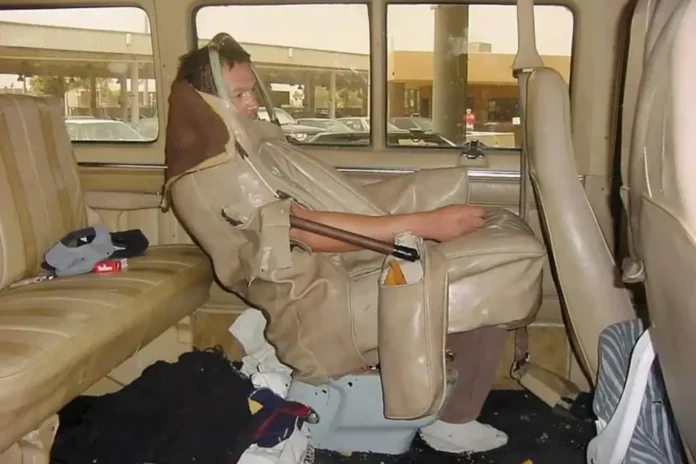
On the morning of June 2001, American customs officials near San Ysidro Port of Entry in the state of California stopped a van to search it routinely. What they saw within the passenger seat shocked them to the core a man’s face pushed through the material of the upholstering. The seat had been carved out and sewn back together over a secreting occupant, his body twisted in a futile effort to go unnoticed.
Enrique Aguilar Canchola, a 42-year-old Mexican citizen, was the man hidden in the seat. The try took place on June 7, 2001, at San Ysidro, the busiest international ground crossing at the time, with over 50 million people passing through each year. He had gorged himself into the hollow compartment of the passenger seat, cut open and resewn to camouflage him as one with the car. The inspectors noticed the ruse because of the peculiar shape and prominent features of the seat, foiling the try virtually instantly. Canchola’s motive lay in economic possibility and perhaps reunification with family, both being typical motivators for such gambles in a time of stringent controls over immigration.
A tweet from X.
Canchola’s choice reflected deep hardship.
“This was one of the patterns of growing undocumented immigration to jam people into slots,”
American immigration officials said in the wires at the time. Confronted with economic inequality between Mexico and America, many such as him paid “smugglers” commonly referred to as “coyotes” about $1,000 each for such perilous arrangements. The cost in human bodies was great: no air to breathe, no mobility, and perils such as suffocation emphasized the human risk.
The early 2000s saw the increased use of innovative smuggling schemes, such as concealed automobile compartments as well as engine hides, during the more than 1.7 million fiscal year 2001 border apprehensions. The United States Immigration and Naturalization Service (INS) took care of enforcement then, passing to the Department of Homeland Security after 9/11. San Ysidro’s high traffic made it a hotspot for these attempts, with agents trained to detect anomalies in vehicles.
“News accounts from the time quote U.S. immigration officials saying the case was an example of a growing and dangeroustrend of migrants hiding in manufactured compartments and vehicle cavities to get past inspections.”
Business Insider, 2015.
Canchola’s case endures as a symbol of migration’s perils. Similar attempts persist globally, like a 2015 engine hide in Spain. In 2025, human smuggling remains a challenge, with U.S. Justice Department data showing increases along northern borders. As borders tighten, these stories remind us of policy’s human side enforcement saves lives from risky crossings, yet broader reforms could address root causes like inequality, reducing the need for such extremes.
