

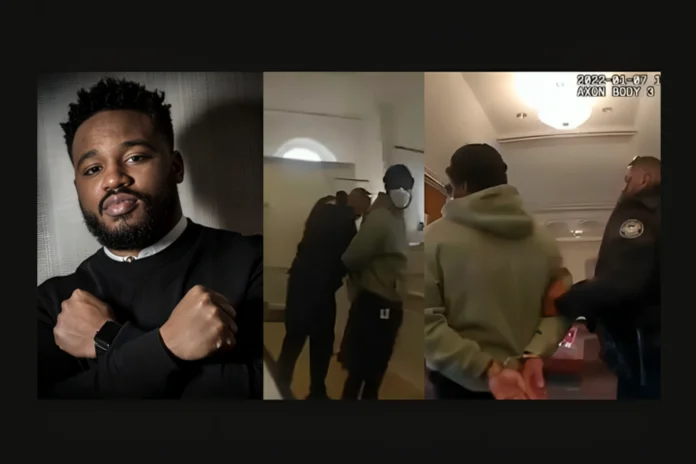
It was a cold January morning when Ryan Coogler, the acclaimed director of Black Panther, entered a Bank of America in Atlanta’s Buckhead neighborhood. His mission: a straightforward one of withdrawing $12,000 from his personal account to pay a healthcare worker. Coogler, visiting the city to shoot Black Panther: Wakanda Forever, proceeded with the transaction discreetly. He presented the cashier with a withdrawal slip that read:
“I would like to withdraw $12,000 cash from checking account. Please make the money count someplace else. I’d prefer discretion.”
He presented his Bank of America debit card and California ID, which is standard procedure for such a request.
A post from X.
But what should have been a routine transaction turned into a terrifying experience. Coogler, wearing a hat and sunglasses and a face mask with a COVID-19 sticker across it, was misidentified as a suspect in an attempted robbery. The pregnant Black woman cashier panicked when the note and the amount of money alerted an automatic bank alert when someone makes a withdrawal greater than $10,000. She notified her manager, and within minutes the police arrived.
Atlanta police quickly arrived and arrested two of Coogler’s coworkers who were standing outside in an SUV. Officers entered the bank and approached Coogler inside with care, momentarily drawing their guns before handcuffing him. His body camera captured his confusion as he asked, “What’s going on?” Director Coogler, known for his films that grapple with racial injustice, found himself the unwitting victim of an in-real-life miscommunication.
“I just had weapons pointed at me for taking out cash from my own account,”
he told police officers and asked them for their badge numbers.
After the verification of his identity and account details, the officers let Coogler and his friends go within minutes with an apology. The short-lived event left a lasting impression with individuals pondering how a visit to the bank had taken such a sudden turn.
Bank of America acted quickly too, issuing a public apology:
“We apologize deeply that this happened. It ought not have happened, and we have already apologized to Mr. Coogler.”
Coogler accepted the resolution as well, speaking with Variety:
“This should never have happened. Bank of America cooperated with me and rectified the matter to my liking nonetheless, and we have moved forward.”
Despite the amicable resolution, the incident sparked widespread debate about systemic issues in banking and beyond.
Word of the arrest of Coogler spread quickly, inspiring outrage on social networks such as X and Reddit. Many decried the incident as a textbook case of “banking while Black,” a term used to describe the disproportionate scrutiny Black individuals face in financial settings. The NAACP condemned the bank’s actions, pointing to broader patterns of racial profiling. Posts on X including one from @YayAreaNews in January 2025, kept the story alive, with users expressing frustration over persistent bias. A Reddit thread in April 2025 garnered over 50,000 votes, reflecting ongoing public discontent.
The following incident resonated strongly, even more so considering Coogler’s body of work. His first movie, Fruitvale Station, documented the police shooting of Oscar Grant, and Black Panther served as a cultural touchstone for celebrating Blackness. It should have been unthinkable that a filmmaker of Coogler’s caliber should experience such treatment. It served as a sobering reminder that no amount of success protects Black people from distrust.
The Coogler case is symptomatic of a wider trend. A 2021 Pew Research study reported that 35% of Black Americans had experienced discrimination in financial situations, as opposed to 15% of white Americans. Cases such as that of Sauntore Thomas, a Black man questioned when he cashed a settlement check in 2020, capture the difficulties of pursuing institutional interactions as a Black person. Coogler’s experience, fueled by his celebrity status, reiterated the issues of implicit bias and the necessity for more comprehensive banks’ staff training.
Critics questioned why the teller didn’t verify Coogler’s identity before escalating the situation, pointing to gaps in Bank of America’s protocols. The teller’s own identity as a Black woman added complexity, with some X users suggesting internalized bias or class-based prejudice played a role. Others defended her, citing her pregnancy and training to flag suspicious behavior.

