


A 21-year-old former flight attendant from South London has found herself at the heart of a chilling international drug trafficking case involving a deadly new drug—one made, shockingly, with human bones.
Charlotte May Lee, who once worked in the skies serving passengers with a smile, is now behind bars in a Sri Lankan prison, accused of smuggling over 100 pounds of “kush”—a sinister synthetic drug that originated in West Africa. The drug, linked to dozens of deaths weekly in countries like Sierra Leone, was found stuffed inside her suitcases when she landed at Colombo’s Bandaranaike International Airport on May 12.
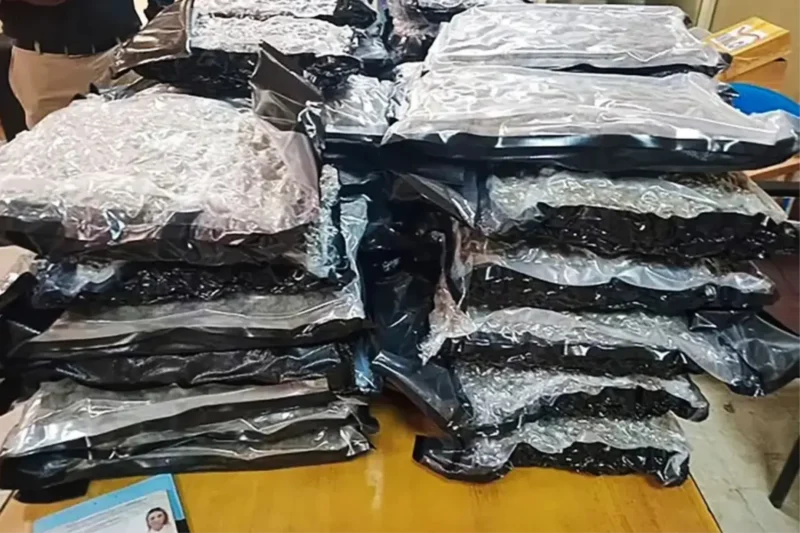
When authorities discovered the drugs, they were estimated to be worth $3.3 million. Lee insists the drugs were planted without her knowledge, a claim supported by her lawyer, exploration, Sampath Perera, who visits her daily at Negombo prison. She is currently detained in a jail north of Colombo, enduring harsh conditions, including sleeping on a concrete floor.
“I had no clue,”
She told reporters from her jail cell.
“I thought my bags were full of my clothes and stuff—not drugs!”
She’s sticking to her story, claiming someone planted the kush in her luggage.
“They must have done it—I even know who,”
Now, she’s stuck in a rough jail north of Colombo, sleeping on a cold concrete floor, while her lawyer, Sampath Perera, fights to clear her name. If she loses, she’s looking at 25 years behind bars.
Kush is a synthetic drug originating from West Africa, particularly Sierra Leone, where it has been a growing concern for approximately seven years. It is a dangerous concoction typically combining cannabis, fentanyl, tramadol, and formaldehyde. Early reports stirred controversy by suggesting the drug might contain ground-up human bones sourced from graveyards. However, laboratory analyses have not confirmed this, identifying instead a plant base like marshmallow mixed with synthetic cannabinoids and nitazene-based opioids. The claim about human bones remains unverified and contentious.
The drug’s impact is catastrophic, particularly in Sierra Leone, where it has triggered a national emergency. Highly addictive, kush users may consume up to 40 joints daily, leading to hundreds of deaths from organ failure and a staggering 4,000% surge in psychiatric hospital admissions between 2020 and 2023. In 2024, Sierra Leone’s president, Julius Maada Bio, declared a national emergency, labeling the situation an “existential crisis” due to the drug’s devastating toll.

Lee’s arrest is part of a broader crackdown on kush trafficking, with Sri Lankan authorities reporting a rise in drug trafficking from regions like Bangkok. This seizure ranks among the largest drug-related busts involving synthetic substances at Bandaranaike Airport, underscoring the global scope of the kush trade.
A year ago, Lee was jetting across Asia, living what many would consider a dream life. She shared beach selfies, airport lounges, and travel tips with a growing fan base on social media. Her story had an almost cinematic appeal—young, adventurous, and ambitious.
A post from X.
But now, she’s sleeping on a concrete floor in a prison north of Colombo, awaiting a verdict that could see her spend the next 25 years behind bars.
Despite the harsh conditions, her lawyer says she’s in contact with her family, who are shocked and desperately hoping for her release.
In Sierra Leone, efforts to combat kush include “Operation Zero Tolerance” and heightened cemetery security to deter grave robbing, despite the unconfirmed nature of the human bone claims. The drug’s spread to neighboring Guinea and Liberia, aided by porous borders, further complicates containment efforts.


