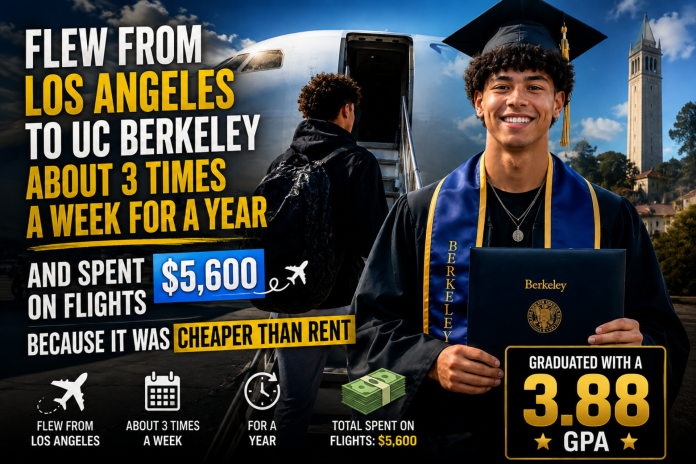
Bill Zhou, a then-26-year-old transportation engineering student with prior professional experience in Southern California, completed his entire Master of Engineering (M.Eng) program at UC Berkeley by flying commercial planes from Los Angeles roughly three times every week for nearly a full academic year, spending only about $5,600 on the complete commute because Bay Area rents proved far higher, and he still graduated with a 3.88 grade-point average without missing a single class.
The events unfolded during the 2022-23 academic year, with classes running from August 2022 through May 2023 at the University of California, Berkeley, campus in Berkeley, California, while Zhou maintained his primary residence in a rent-controlled apartment in Los Angeles, subject to the city’s long-standing limits on annual rent increases. He had already worked as a transportation engineer in Southern California and planned to return to that same employer immediately after earning the degree. Private bedroom units near campus typically demanded $1,500 to $2,000 each month, and most landlords required a full 12-month lease even though the intensive program lasted only about eight to 10 months of actual instruction time, pushing projected housing costs near $20,000. Zhou calculated that staying put in Los Angeles and flying in for class days would cost far less, especially once he factored in the hundreds of thousands of frequent-flyer miles and points he had already accumulated through earlier leisure travel and everyday spending.
He structured his course load to concentrate almost all required sessions on Mondays, Wednesdays, and Fridays, so that most weeks involved only three round trips. A standard day began with an alarm between 3:30 and 5:40 a.m., followed by a short drive to inexpensive parking near Los Angeles International Airport (LAX), a shuttle ride to the terminal, and an early departure usually between 5:30 and 8:20 a.m. bound for San Francisco International (SFO) or Oakland International (OAK). After landing he spent time in airline lounges catching up on homework and email before boarding Bay Area Rapid Transit (BART), the Bay Area’s regional rail system, for the ride into Berkeley, and then transferring to a local bus or campus shuttle to reach classrooms that started as early as 8 a.m. or closer to midday. Afternoons often included extra project work or meetings before the reverse journey on evening flights that returned him home between 9:30 p.m. and midnight. Across the year he completed 114 trips involving 238 individual flights and more than 92,000 air miles, while the cumulative door-to-door transit time reached 75,955 minutes, the equivalent of nearly 53 full days.
Cash outlays for the plane tickets themselves totaled only about $2,413 because the majority of seats were secured with Alaska Airlines mileage awards that required little more than taxes, plus Southwest points purchased during sales and smaller redemptions on other carriers, a strategy that has become more attractive as airlines have tightened the rules around their frequent-flier programs. Ground costs added parking at $3 a day, gas for the airport runs, transit fares, and occasional in-flight internet, bringing the grand total to $5,592 according to his own carefully tracked records. One traffic citation added a further $491 in some tallies, pushing the final figure nearer $6,100, yet the amount still remained dramatically lower than a local lease. Zhou never spent a night in a Bay Area hotel or even at a friend’s place, even though classmates repeatedly offered lodging. Typical hotel rates near campus easily exceeded $200 per night, so the same-day return policy eliminated that entire category of expense and kept the budget intact.
Zhou later provided a detailed public accounting of every expense and flight that confirmed the numbers and described how elite-status privileges allowed free same-day changes when campus events or group projects ran late. A first-person narrative of the daily logistics explained the early-semester exhaustion during an intensive boot-camp period when he flew five days a week and nearly quit before deciding the tickets were already booked. University channels published a reflective account in which Zhou noted that his long-standing fascination with aviation and public transit systems made the long hours feel more like repeated short trips than pure drudgery. Airline staff at the San Francisco lounge even nicknamed him after his regular ginger-beer order, and the carrier later surprised him with a subscription travel pass after graduation as recorded in an official recognition of the pattern.