

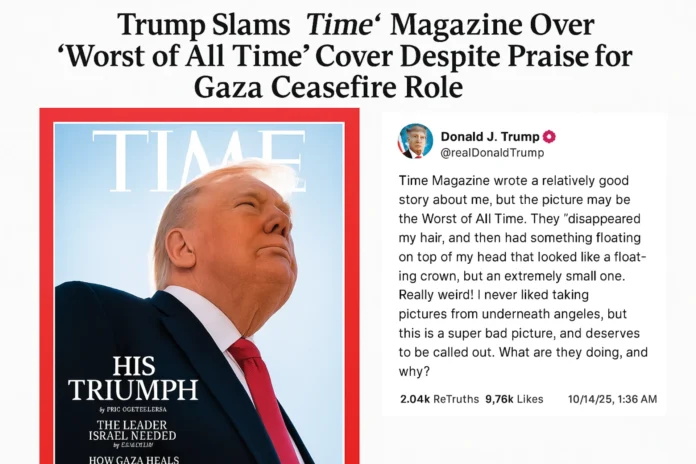
President Donald Trump is once again at odds with the media — this time targeting Time Magazine for what he called “the Worst of All Time” photo on its latest cover, even as the publication celebrated his diplomatic success in helping broker the Gaza ceasefire agreement.
The November 10, 2025, issue of Time features Trump under the headline “His Triumph,” accompanied by a dramatic low-angle photograph taken against bright sunlight. Instead, the image, intended to symbolize his stature and role in achieving peace in the Middle East, drew sharp criticism from the president, who claimed the lighting made his hair “disappear.”
In a Truth Social post published at 1:30 a.m. ET on Tuesday, Trump wrote:
“They ‘disappeared’ my hair, and then had something floating on top of my head that looked like a floating crown, but an extremely small one. Really weird! I never liked taking pictures from underneath angles, but this is a super bad picture, and deserves to be called out. What are they doing, and why?”
Despite conceding that Time “wrote a relatively good story,” Trump accused the magazine’s editors of deliberately choosing an unflattering image.
Photography experts say the “vanishing hair” Trump described is an optical effect caused by strong backlighting. Because the photo was taken on a bright, sunny day with the sun directly behind him, overexposure caused parts of his hair to blend into the white sky.
“The photographer exposed for the shadows on his face, not the sky,” said New York portrait photographer Ellen Meyers. “That’s why his hair looks almost invisible and the halo-like glow appears around his head.”
Experts also noted that low-angle shots, such as the one used for the cover, can emphasize features like the chin and nostrils, making them less flattering. The combination of angle and wide lens may have unintentionally exaggerated Trump’s proportions — a common source of discontent in portrait subjects.
Ironically, the cover story itself casts Trump in a positive light, portraying his role in negotiating the Gaza ceasefire as one of the signature accomplishments of his second term.
The U.S.-brokered deal led to the release of 20 remaining Israeli hostages held by Hamas, the freeing of 2,000 Palestinian prisoners, and the return of 360 Palestinian remains. The agreement was mediated with assistance from Secretary of State Marco Rubio, Special Envoy Steve Witkoff, and advisor Jared Kushner.
Trump marked the occasion with visits to Jerusalem and Sharm El Sheikh, addressing the Israeli Knesset and meeting Egyptian President Abdel Fattah el-Sissi, who reportedly told him, “Only you can bring peace to the region.”
Israeli officials have even voiced support for Trump’s nomination for the 2026 Nobel Peace Prize for his role in ending hostilities.
The controversy quickly dominated social media, with Trump’s late-night post overshadowing discussion of his diplomatic success. Supporters accused Time of “sabotaging” his image, while critics mocked his sensitivity to perceived slights in the media.
Time Magazine has not commented publicly on Trump’s criticism. The publication hailed the ceasefire as “a strategic turning point for the Middle East — a shift from conflict toward the possibility of transformation.”
The episode underscores a familiar tension in Trump’s relationship with the press — his desire for recognition often complicated by his sensitivity to presentation. Even as he claims credit for what some describe as a historic peace accord, his focus on the aesthetics of a magazine cover has once again drawn its own headlines.
As one commentator on X (formerly Twitter) put it: “Only Trump could turn a peace deal into a photo dispute.”
