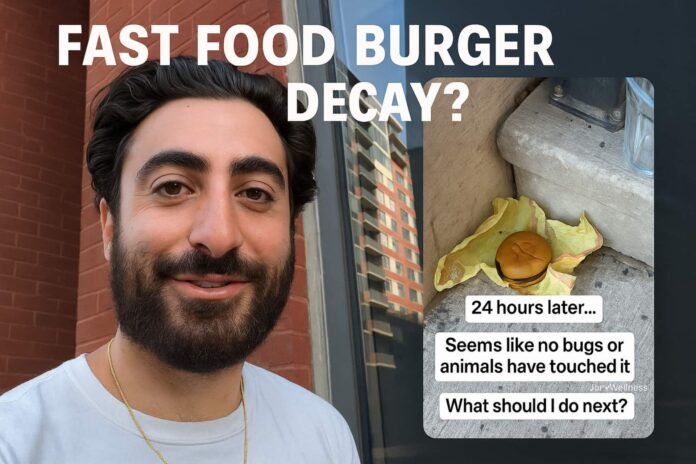
A McDonald’s cheeseburger left untouched in a backyard has reignited a decades-old debate about fast food’s durability. An American, known online as @joeywellness, purchased a classic McDonald’s cheeseburger to test a viral theory: that the chain’s food is so laden with chemicals it resists mold, decay, and even nature’s scavengers.
In a series of TikTok videos posted in April and May 2025, Joey documented his experiment, leaving the burger outside to see if bugs or wildlife would eat it.
His findings, which exploded online with over 3 million views, have fueled speculation about what’s really in our fast food. But is this proof of unnatural ingredients, or is there a simpler explanation? Here’s the full story, including Joey’s own words and what science reveals.
Joey kicked off his experiment with enthusiasm, stating in his first video,
“So I have a McDonald’s cheeseburger because I’m doing a little experiment. It’s a classic cheeseburger, smells delicious, but I’m leaving it here outside and I want to see if any animals or bugs go to eat it, right?”
He laid out his reasoning clearly:
“It’s a good rule of thumb to see how real the food is, right? So if nature won’t eat it, then we probably shouldn’t be consuming it either. Good rule of thumb to have.”
He placed the unwrapped burger outdoors, vowing to check back. He concluded,
“So I’ll leave it here and I’ll see how long it takes until any bugs or animals have a little bite at it.”
After 14 hours, Joey returned for an update, observing,
“Got some sunshine, a little fresh air, a little salt in my water. Yo, it’s still here. So it seems like no wild animal has touched it.”
He had expected interest from creatures like
“a raccoon or I don’t know, skunk, groundhog, nothing.”
The burger, he noted, had changed slightly:
“It is a little hard. I guess it got cold overnight. It’s not rock hard, but it’s still kind of squishy.”
Undeterred, he decided to extend the experiment, saying,
“Nothing so far. I’ll leave it out for a second day, especially that today’s going to be nice and hot. We’ll see what happens.”
By the 24-hour mark, the McDonald’s cheeseburger remained untouched, amplifying Joey’s surprise. Follow-up videos in the series, posted over several days, showed minimal changes. Small bugs appeared nearby but didn’t eat the burger, and wildlife like squirrels or birds ignored it. In later clips, Joey remarked that “animals can sense bad food,” suggesting humans should question eating what nature rejects. His posts, mirrored on platforms like X, sparked widespread discussion, with one repost by @WallStreetApes garnering millions of views and fueling claims that McDonald’s food is unnaturally preserved.
This isn’t a new narrative. The idea that McDonald’s burgers “don’t rot” has circulated for years, with viral examples like a 1995 burger in Australia, a 2004 burger looking pristine in 2025, and a 2009 Happy Meal from Iceland displayed after a decade without decay. Other experiments have kept the myth alive, like a 2022 school test comparing a cheeseburger to a rotting cucumber or a 2023 TikTok leaving a burger out for 30 days. Many attribute this to excessive preservatives, with Joey’s experiment adding to the chorus by suggesting even bugs and animals avoid the food.
However, experts offer a less sensational explanation. McDonald’s burgers, made with 100% USDA-inspected beef and no added preservatives in the patties, resist visible decay because they dry out quickly. Thin, well-cooked patties lose moisture fast in dry environments, mimicking the preservation of beef jerky or crackers. Tests by food scientists, like those at Serious Eats, compared McDonald’s burgers to homemade ones of similar size. Both resisted mold when left in open air due to dehydration, not chemicals. In humid conditions, McDonald’s confirms, their burgers rot like any other food. Joey’s burger, exposed for just 24 hours in likely dry conditions, fits this pattern.
The lack of interest in bugs or wildlife also has natural explanations. Animals like raccoons or groundhogs may be scarce in urban or suburban settings. Dry, hard food is less appealing to bugs or animals, especially over a short period like 24 hours. Anecdotal videos of animals rejecting fast food—like a bear ignoring a Big Mac or ants bypassing a burger—circulate online, but controlled tests show animals will eat processed food when hungry. Joey’s experiment, while compelling, lacks scientific rigor, as factors like location, weather, and short duration skew results.
Despite the debunking, the myth persists because it taps into distrust of fast food. At about 300 calories, a McDonald’s cheeseburger contains simple ingredients: beef, bun, cheese, pickles, onions, ketchup, and mustard. High salt and sugar content raise health concerns, but no “mystery chemicals” prevent decay. For those curious about fast food’s makeup, resources like Nutritionix break down ingredients clearly.