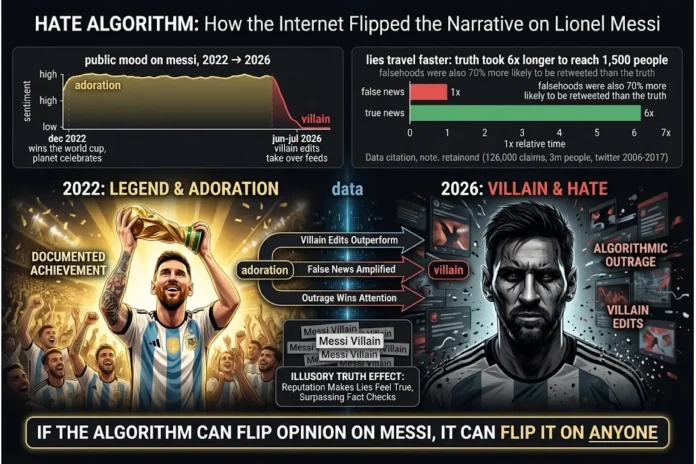
Online criticism of Lionel Messi has intensified in recent months, driven by a combination of social media recommendation algorithms, debates over officiating during Argentina’s 2026 FIFA World Cup campaign, and longstanding associations that some critics have politicized. Messi led Argentina to the 2022 World Cup title amid global celebration. Three and a half years later, segments of the internet portray him in sharply negative terms despite no fundamental change in his on-pitch excellence or career trajectory. Two decades of professional football match archives, referee data, and video records remain publicly available for review.
Social media recommendation systems play a significant role in amplifying negative content. Platforms prioritize material that generates strong engagement, which often favors dramatic or critical edits over balanced highlights. A landmark 2018 study published in the journal Science by researchers at the Massachusetts Institute of Technology analyzed the spread of verified true and false news on what was then Twitter, examining approximately 126,000 rumors spread by roughly three million users over 11 years. It found that false stories diffused six times faster than true ones and were 70 percent more likely to be retweeted. Human behavior, rather than bots alone, largely accounted for the difference, as emotionally charged content tends to hold attention longer.
The illusory truth effect further contributes to this dynamic. Psychological research published in Collabra: Psychology demonstrates that repeated exposure to a claim increases the likelihood that people will perceive it as true, even when they initially knew otherwise or encountered corrections. This process does not require a single fabricated narrative. Football ranks among the most thoroughly documented sports, with multiple camera angles, referee decisions, and match data preserved for nearly every game. Yet selective framing can still shape broader perceptions when it circulates widely.
Argentina advanced deep into the 2026 tournament, with Messi continuing to set scoring records as the all-time leading men’s World Cup goalscorer. However, several matches drew formal complaints from opposing teams regarding refereeing decisions and VAR interventions. Algeria lodged an official complaint after a group-stage match in which Messi was not sent off for a challenge on defender Aissa Mandi that some argued warranted a red card, a decision that came between Messi’s first and second goals in a 3-0 win. Egypt filed complaints following their round-of-16 exit, citing specific calls. FIFA refereeing officials have consistently rejected allegations of systemic bias, emphasizing the independence of match officials. Argentina ultimately reached the final but fell 1-0 to Spain in extra time, after which some Argentine media criticized the decision to award the Golden Ball to Spain’s Rodri rather than Messi, a choice that drew pushback from fans.
Messi’s documented football-related connections to Israel have become another focal point for certain critics, particularly in parts of the Muslim and Arab world. In July 2013, while playing for Barcelona, Messi participated in the club’s preseason “peace tour,” which included a visit to the Western Wall in Jerusalem where players wore yarmulkes, a meeting with Israeli President Shimon Peres and Prime Minister Benjamin Netanyahu, and skills clinics involving both Israeli and Palestinian children. Earlier that same month, he sent a supportive message to Argentina’s delegation for the Maccabiah Games in Israel, often called the Jewish Olympics. He later served as a brand ambassador for OrCam, which produces assistive devices for the visually impaired, and for Sirin Labs, a technology company. He is Catholic and has made no verified public statements endorsing political positions in the Israeli Palestinian conflict or donating funds to Israel in the ways claimed in viral posts. Fact-checkers have repeatedly debunked a claim that he donated $1.5 million to Israel, which originated from a satirical social media post and was mispresented as news.
Other elements from Messi’s career have periodically resurfaced in critical discussions. These include past tax-related legal matters in Spain involving his father, an incident involving a handball goal early in his Barcelona career, and exchanges with opponents during high-stakes matches. Argentina’s national team has faced scrutiny at times for on-field behavior or post-match incidents involving supporters or players. Off-field matters, such as crowd-management issues at certain exhibition events, have also drawn attention. These episodes occur alongside Messi’s consistent record of individual and team success at the highest levels of the sport.
• MIT study on false news spread (Science journal): Science.org
• Illusory truth effect research (Collabra: Psychology): UC Press Collabra
• Fact-check on Messi donation claim: Snopes
• Messi Maccabiah Games and Israel history: Times of Israel