

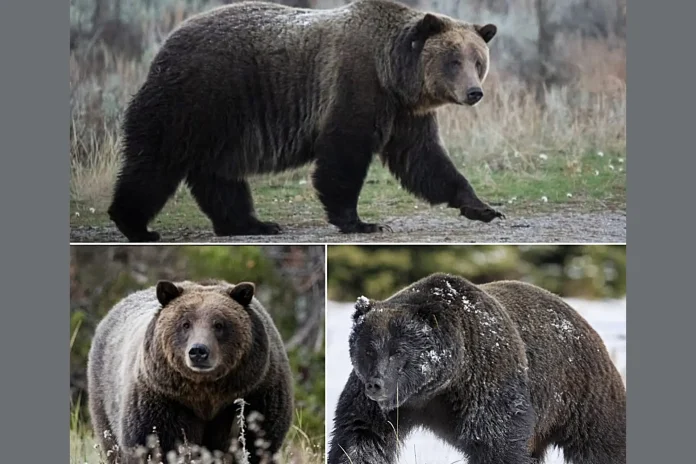
Deep in the Canadian Rockies, a grizzly bear called “The Boss” has lived a life so extreme that even seasoned wildlife biologists shake their heads in disbelief.
Bear 122, as the collar reads, tips the scales at close to 700 pounds and rules one of the largest home ranges ever recorded for a grizzly—more than 2,500 square kilometers across three national parks. He earned his nickname the hard way: by driving off every challenger, devouring black bears whole when food ran short, and walking away from a head-on collision with a freight train that would have turned most animals into a memory.
The train strike happened years ago near Vermilion Lakes, a quiet wetland just minutes from Banff’s tourist crowds. GPS points from his research collar showed him lingering on the tracks, feeding on grain spilled from hopper cars, when a locomotive hit him at full speed. Trains in that corridor move faster than 70 miles per hour and rarely leave survivors. Yet minutes later the signal kept moving—he stood up, shook himself off, and limped into the forest as if nothing had happened. Parks Canada specialists still cite his case when explaining why larger, older males sometimes beat odds that kill younger bears outright.
His genetic legacy runs even deeper than his scars. DNA collected from hair snares and scat across the Bow Valley reveals he has fathered litter after litter, with field estimates placing him as the sire of roughly seven out of every ten cubs born in his core territory over the past decade. That level of dominance is rare in grizzlies, where several males usually share paternity. In a population of only about 65 bears squeezed between highways and rail lines, one animal carrying that much reproductive weight becomes a living insurance policy for the entire group.
Even in 2025, at an age when most wild grizzlies have long since disappeared, The Boss keeps showing up. He was spotted in early March emerging from his den, always the first bear out each year, and again in October digging roots along the Trans-Canada Highway. In May he narrowly escaped tragedy when a female he was courting stepped onto the tracks near Lake Louise and was killed instantly; he bolted at the sound of the horn and lived to mate another day. Those who monitor him daily say he now recognizes the rumble of an approaching train and clears the rails faster than he once did.
Stories like his do more than entertain—they force tough questions about how we share the landscape with large predators. Railway companies have already reduced grain spills and installed experimental warning systems because data from bears like him proved the danger is real. Still, three grizzlies died on those same tracks in the summer of 2025 alone. Until overpasses and fencing cover more miles, survival will keep depending on individual luck and hard-earned street smarts—the exact combination that has kept The Boss alive against everything the mountains have thrown at him.
For a detailed account of the train collision and recovery, see this report from Parks Canada researchers. Background on his reproductive dominance appears in regional genetic monitoring summaries (Calgary Herald). Recent conservation challenges and 2025 fatalities are covered here (Rocky Mountain Outlook).
