

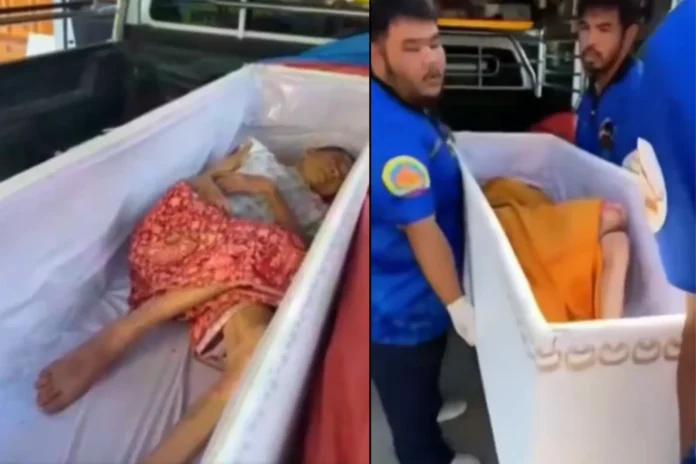
In a heart-stopping moment at a quiet Buddhist temple on the outskirts of Bangkok, faint knocks echoed from inside a sealed coffin, revealing that a 65-year-old woman was still alive just minutes before she was due to be cremated. The extraordinary incident occurred on November 23, 2025, when her brother arrived at Wat Rat Prakhong Tham in Nonthaburi province after driving more than 500 kilometers from Phitsanulok in northern Thailand. The near tragedy has spotlighted the risks of declaring death without formal medical verification in rural areas.
The woman had been bedridden for two years due to deteriorating health. Two days earlier she had become completely unresponsive and appeared to stop breathing. Believing she had passed away, her brother placed her in a simple white coffin and set out to honor her long-expressed wish for organ donation at a hospital in the capital.
The hospital refused to accept the body because there was no official death certificate, a requirement that is frequently bypassed in remote communities. The brother then drove to Wat Rat Prakhong Tham, a temple known for offering free cremations to those in need. Staff there also initially declined to proceed without proper documentation.
While Pairat Soodthoop, the temple’s general and financial affairs manager, was explaining how to obtain the certificate from local authorities, a faint but unmistakable knocking sound came from the coffin still sitting in the bed of the pickup truck.
“I was a bit surprised, so I asked them to open the coffin, and everyone was startled. I saw her opening her eyes slightly and knocking on the side of the coffin — she must have been knocking for quite some time.”
— Pairat Soodthoop, temple manager
When the lid was lifted, the woman was found weakly moving her arms and head. Emergency services were called immediately. Medics later diagnosed severe hypoglycemia, a critical drop in blood sugar that can cause profound unconsciousness and mimic death without actual cardiac or respiratory failure.
Temple staff recorded the dramatic scene and posted the video on several social media accounts, where it rapidly went viral, drawing both relief and concern from viewers worldwide. The temple abbot pledged to cover all of the woman’s medical expenses.
As of November 25, 2025, the woman remains hospitalized in Nonthaburi Province with no further updates on her condition available to the public. Similar cases of apparent death followed by revival, though rare, have been documented globally and are often linked to metabolic crises rather than actual clinical death.
The incident serves as a potent reminder that even in an age of advanced medicine, the final determination of death must never be left to assumption, especially for the elderly and chronically ill in underserved regions.
