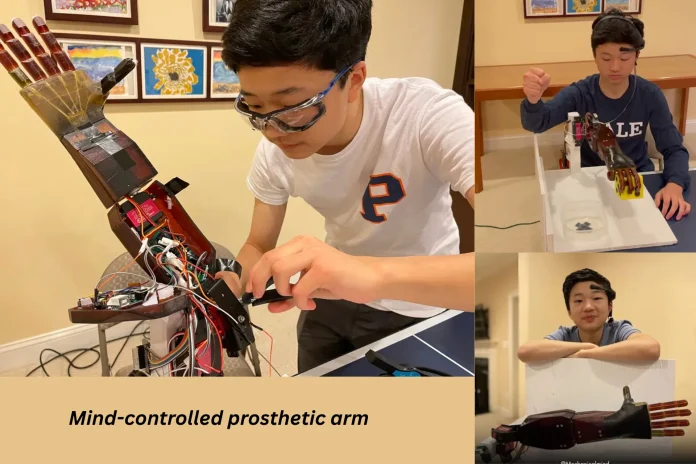
A high school student from McLean, Virginia, is earning national attention after creating a groundbreaking, mind-controlled prosthetic arm — using just a $75 3D printer, fishing line, and a makeshift basement lab.
Benjamin Choi, now approximately 20, grew up in McLean, VA, and attended the Potomac School, where he spent his free time tinkering with robotics, playing the violin, writing short stories, and competing on quiz teams. He taught himself Python and C++ before high school and says the inspiration for the prosthetic came when he watched a 60 Minutes segment in third grade about robotic limbs controlled through brain implants.
“I was really impressed — but also alarmed,” Choi told Smithsonian Magazine, recalling the invasive brain surgery and staggering costs involved.
When the COVID-19 shutdowns hit in 2020, the then-15-year-old transformed his basement into a lab using his sister’s $75 3D printer. That’s where he built the first version of the arm.
By 2022, Choi had become a Regeneron Science Talent Search Top 40 finalist, a U.S. Presidential Scholar, and a Davidson Fellows Laureate (earning a $50,000 scholarship). After graduating from high school, he enrolled at Harvard University, where he continues to study engineering and publish research.
A Mind-Controlled Arm — Without Surgery
Choi’s prosthetic arm functions similarly to $450,000–$500,000 industry models — but without requiring brain implants.
Instead, it relies on just two EEG electrodes:
- One attached to the earlobe as a baseline
- One is placed on the forehead, where it can pick up motor-intent brain signals
These signals are filtered, interpreted, and transmitted via Bluetooth to a chip in the arm. Users think “clench” or “unclench” to control the hand. They can also nod to lift the arm or blink intentionally to stop movement.
The response time? Under a second.
The AI Behind the Breakthrough
Choi wrote more than 23,000 lines of code, building a custom neural network trained on brain-wave data collected from six adult volunteers. That dataset included input from amputee Joseph Dunn of Pennsylvania, who discovered Choi’s early YouTube demos and later offered real-world feedback.
The final algorithm:
- Achieves 95% accuracy (compared to ~73.8% for top commercial systems)
- Adapts to individual users over time
- Runs directly on a dual-core microchip after cloud processing proved too slow
Choi’s math notes for the project spanned nearly 1,000 pages.
The Hardware: Built for $300
The arm’s structure was printed in dozens of small pieces on a low-cost printer and assembled with bolts, servos, rubber bands, and fishing line. After more than 75 prototypes, Choi upgraded to durable resins — including materials supplied through a manufacturing grant from polySpectra.
The total cost:
- ~$150 for the arm
- ~$150 for the EEG components
- ≈ $300 overall
Choi also published open-source build instructions, allowing others to replicate it.
Bornet’s post reignited debate by comparing Choi’s creation to commercial prosthetics that can reach nearly half a million dollars and often require invasive surgery.
Replies on X ranged from admiration (“This kid should run NASA”) to skepticism (“A prototype isn’t a medical device; costs include safety and regulations”). Others tied it to similar DIY innovations in healthcare, including low-budget dialysis machines and open-source insulin pumps.
Advocates for affordable assistive tech say Choi’s project demonstrates how open-source tools and consumer-grade AI could dramatically lower costs for people with disabilities worldwide — especially in low-income countries, where only about 10% of amputees can access prosthetics.
Now a Harvard engineering student, Choi is continuing his research in neuroprosthetics. A 2025 paper in the Journal of Neural Engineering, co-authored with MIT collaborators, validates the accuracy and reliability of his EEG-AI integration.
He is planning clinical studies and long-term patient trials, though commercialization will require navigating FDA processes and safety testing.
Choi also sees wider applications for the technology, including:
- Communication tools for ALS patients
- Hands-free wheelchair control
- Accessibility devices for people with paralysis
As of December 2025, no commercial product has launched — but the momentum behind the research continues to grow, fueled in part by the viral post that brought the story back into the spotlight.
What began as a pandemic basement project may turn out to be one of the most disruptive ideas in modern prosthetics — and a reminder that sometimes, innovation comes from outside the system.