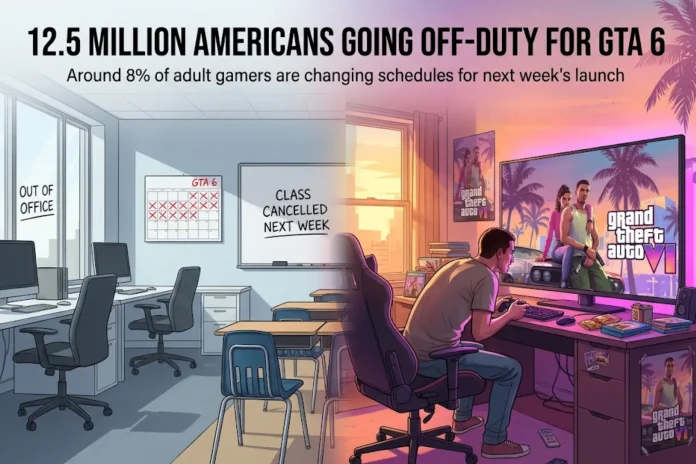
Roughly 12.5 million American gamers could adjust their work or school schedules next week to play Grand Theft Auto 6 when it launches on Thursday, according to a new survey. The figure comes from a PCMag-commissioned YouGov poll conducted online between October 23 and 27 among 2,024 U.S. adults, of whom 1,154 identified as gamers. Eight percent of those gamers said they planned to take paid time off or shift their routines for the release.
The survey breaks the plans down further. About 3 percent of the gamers surveyed intended to take two or more days, another 3 percent a full day, and 2 percent a half-day or adjusted hours. Generation Z respondents showed the strongest interest at 13 percent, while men edged women 9 percent to 7 percent. Seven percent of gamers said they planned to upgrade their consoles specifically for this title or a similar major release. Sixty-eight percent of all U.S. adults surveyed said they did not plan to play the game at launch.
The 12.5 million estimate extrapolates the 8 percent response rate against Census figures for the adult population and the share who game. It measures stated intentions rather than confirmed leave requests, so actual absences are expected to come in lower.
Separate data from HR software firm BambooHR points to real movement in calendars. Paid-time-off requests for November 19 were running about 13 percent higher than comparable third Thursdays in recent years across millions of U.S. employees on its platform. Requests for the following Friday and weekend also rose. In a companion BambooHR survey of salaried workers, 18 percent said they planned to take the day, rising to 32 percent among Gen Z and 27 percent among millennials. Roughly half of those planning time off for a game release said they would call in sick instead of booking formal leave in advance.
Workforce platforms that track frontline shifts have recorded similar patterns around earlier major midweek launches. Absenteeism has nearly doubled on some Thursday releases compared with baseline weeks, as workers clear schedules for pre-loading and day-one play. When Grand Theft Auto 5 arrived in 2013, reader polls already showed high numbers planning time off or joking about “GTA flu.” The difference now is systematic tracking by HR systems rather than scattered anecdotes.
Economist José García Montalvo of Pompeu Fabra University in Barcelona has projected that roughly 1.5 million U.S. absences could translate to about $1 billion in short-term lost productivity, based on average output assumptions. Those numbers are approximate and have drawn methodological questions. They sit in the same ballpark as the cash-flow impact Take-Two Interactive has signaled for the launch, meaning much of the economic activity would shift toward the publisher and Rockstar Games rather than disappear.
Similar calculations have surfaced elsewhere. British estimates have put potential lost working time in the hundreds of millions of pounds. Australian analyses have pointed to tens of millions in impact and elevated leave bookings, especially among men aged 18 to 44. Technology and younger male-heavy sectors appear most exposed.
Pre-order numbers underscore the scale of interest. Sensor Tower estimates put pre-purchases near 9.7 to 10 million shortly before launch, already generating roughly $900 million or more in gross revenue. The title has become the most pre-ordered game in the history of both the PlayStation Store and the Microsoft Store, with PlayStation accounting for about three-quarters of the total. Further gains are expected in the final days.
Some institutions have responded directly. The 9th Brigade Engineer Battalion of the 3rd Infantry Division at Fort Stewart, Georgia, offered eligible soldiers a special four-day pass timed to the launch window as a reenlistment incentive. Soldiers who signed contracts for two to six additional years between August 1 and November 14 could receive the pass, subject to command approval. Battalion commander Lt. Col. Ryan D. Hodgson authorized the program. Division spokesperson Lt. Col. Angel Tomko confirmed it was designed to boost retention and morale by connecting to something soldiers were already talking about. By mid-August, about 20 of roughly 130 eligible soldiers had accepted. The offer is limited to that unit.
Private companies have taken similar steps. Pocketpair, the studio behind Palworld, granted staff five days of special leave from November 19 to 23, framing it as an urgent business trip to the game’s fictional Vice City for anyone planning to play. California performance-parts firm Burger Motorsports announced a full operational pause on launch day, describing the release as an unprecedented cultural event. Canadian manufacturer Edison Motors gave employees a long weekend. Hardware maker Logitech created a paid “Logi Game Day” that employees can take around the launch window, presenting gaming as beneficial for readiness and creativity.
Take-Two chief executive Strauss Zelnick had earlier remarked that he expected many people to call in sick on November 19. The combination of survey intent, elevated leave requests, record pre-orders, and formal employer policies marks a shift from the joke-driven “GTA flu” talk that accompanied the 2013 release. Gaming releases of this size now register in the same category of scheduling events that HR teams once reserved mainly for major sports or holidays.
Most American adults remain unaffected. Short-term dips in attendance are often offset later, and the revenue flowing to Rockstar and Take-Two represents a clear transfer of economic activity. Still, the data show how thoroughly one long-awaited video game has moved from entertainment release to calendar fixture for a sizable slice of the workforce.