

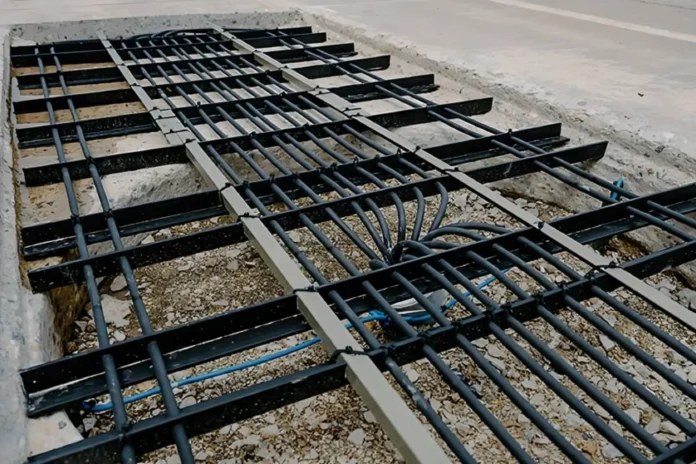
A stretch of ordinary-looking highway just south of Purdue University has quietly become a landmark in American transportation. For the first time in the United States, a heavy-duty electric semi-truck drove at 65 mph while pulling 190 kilowatts of power straight from the road beneath its wheels no plug, no overhead wires, just invisible magnetic fields moving electricity from coils buried in the concrete to receivers on the truck.
A tweet from X.
The quarter-mile test section on U.S. Highway 52/231, completed in partnership with the Indiana Department of Transportation (INDOT), marks the highest-power dynamic wireless charging demonstration ever achieved on a public U.S. road for a Class-8 truck.
“This is a game-changer for long-haul trucking,”
Said Steve Pekarek, Purdue professor of electrical and computer engineering and lead researcher on the project.
“We delivered 190 to 200 kilowatts continuously enough to power roughly 100 homes while the truck cruised at full highway speed.”
The system is built on inductive charging, the same principle used by wireless phone pads but scaled up dramatically. Copper transmitter coils, each about 1.2 m by 0.8 m, lie 4–6 inches beneath the concrete surface. When an authorized truck passes overhead, roadside inverters send 85 kHz alternating current through the coils, creating an oscillating magnetic field. Two 1-square-meter receiver coils mounted under the Cummins electric semi-truck convert that field back into usable electricity to charge the battery in real time.
Peak efficiency hit 92–95 percent when the truck was perfectly aligned, dropping to 80–85 percent with typical lane drift still competitive with many plug-in fast chargers.
Freight trucks produce about 25 percent of all transportation greenhouse-gas emissions in the United States, despite making up only 4% of vehicles on the road. Electrifying them has been difficult because long-haul routes demand huge, expensive batteries that cut into cargo capacity.
“If you charge while you drive on the busiest corridors, you can cut battery size by 50 to 70 percent,”
Explained Nadia Gkritza, Purdue professor of civil engineering and co-lead on the project. Smaller batteries mean lower upfront cost, more payload, and faster adoption of zero-emission trucks.
The same infrastructure can also top up passenger cars and delivery vans, giving states a single investment that works for every electric vehicle.
The catch, as always, is cost. Installing the coils and power electronics runs an estimated $1.5 million to $2.2 million per lane-mile roughly the price of rebuilding a highway anyway. INDOT Commissioner Lyndsay Quist stressed that the technology is designed to be added during normal repaving cycles, not as a standalone project.
Other challenges remain: efficiency falls off at speeds above 70 mph, heavy simultaneous traffic could strain local power grids, and there is still no global standard for coil design and operating frequency.
States like Michigan (testing its own wireless road on I-94) and Utah (planning freight-focused corridors) are watching closely. The Indiana results show the technology is no longer science fiction, but widespread deployment is still years away and will likely start on the nation’s busiest truck routes think I-80 across Pennsylvania and Ohio, I-5 in California, or I-95 along the East Coast.
As with any emerging-technology breakthrough, early headlines sometimes overstate readiness. The Purdue segment is a research test track, not a commercial corridor open to any truck, but the measured power levels and real-world highway speeds are fully substantiated by the research team and third-party observers.
For American freight, which moves roughly 70 percent of the nation’s goods by truck, the Indiana experiment offers the clearest proof yet that zero-emission highways are technically possible. The bigger question now is not whether the technology works it’s how quickly the country is willing to pay to rebuild its interstates for the electric age.

