

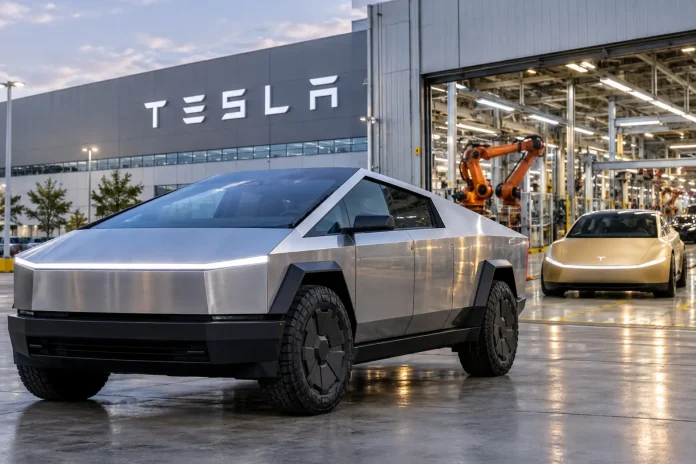
Elon Musk dropped the news straight on X late on November 6, 2026:
“Tesla will be winding down production of the Cybertruck at Gigafactory Texas around the middle of next year to make room for increased Cybercab production.”
The stainless-steel pickup that once looked like the future of American trucks is getting pushed aside for Tesla’s robotaxi bet. Gigafactory Texas near Austin is the only plant that builds the Cybertruck. Musk did not say production would move elsewhere, so this effectively marks the end of the line for new ones after roughly another eight or nine months of output.
The Cybertruck was launched in November 2019 as a highly angular vehicle with a stainless steel frame and a disruptive message in the pickup segment. Annual volumes were projected at around 250,000 by Musk in the past. Delivery was only made possible in 2023 after years of delay. Reality struck hard. The number of vehicles sold in 2024 stood at approximately 38,965 units before falling to 20,237 units in 2025, which represents a 48% fall, according to estimates from Kelley Blue Book.
Prices rose well above those low numbers initially projected. The design was not liked by traditional truck customers. Several recalls occurred in the process. Demand abroad remained modest; some markets were even not pursued. Overall weak demand for pickups in the EV category didn’t help much either.
Musk later replied that the existing Cybertruck fleet
“will be around for a long time” and called it the “best vehicle Tesla has ever made,”
Even as he labeled the wind-down the “end of an era.” Cybertruck lead engineer Wes Morrill added that the vehicle “was an incredible technology development platform and lives on through Cybercab,” while confirming Tesla will keep providing spare parts and service support.
The freed-up space will be occupied by Cybercab, the two-seater robotaxi from Tesla without a steering wheel. Tesla has already commenced a paid test ride operation in Austin, with further expansions planned. This is in line with Tesla’s overall pivot towards AI, autonomy, and robotics; a similar strategy was used previously for ending Model S and Model X production.
This closes one ambitious, polarizing chapter for Tesla’s futuristic pickup. The next high-stakes bet is whether the Cybercab can deliver the scale and commercial success the Cybertruck never quite reached. Existing owners keep their trucks and the support that comes with them. Everyone else gets a clearer signal that Tesla’s future runs on robotaxis.

