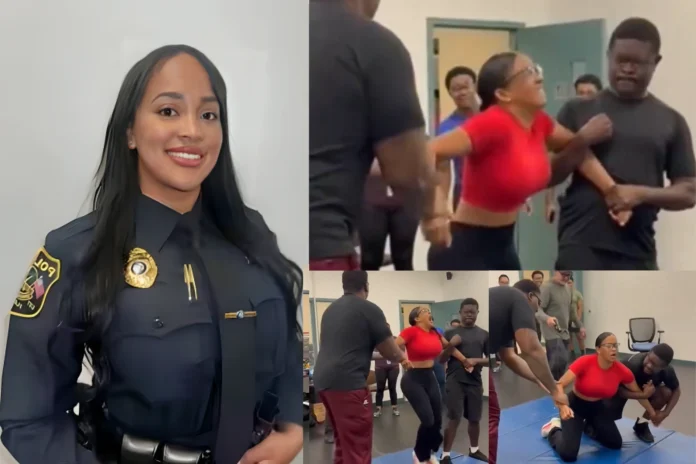
A short police training video is gaining traction online after a clip showing a recruit undergoing a Taser exposure drill quickly spread across social media this week.
The 40-second video shows a female police recruit participating in a controlled training exercise at a police academy. In the footage, the recruit stands on a blue gym mat surrounded by instructors and fellow trainees before being briefly stunned with a conducted-energy weapon as part of a standard training scenario.
The footage captures a commonly used academy exercise sometimes called “Taser exposure,” in which recruits experience the effects of the device firsthand.
In the clip, the recruit — wearing athletic training gear — is positioned on a padded mat while instructors stand nearby as safety observers. Two spotters hold her arms to prevent injury once the electrical current is delivered.
Moments later, an instructor deploys a Taser device, triggering a brief electrical cycle that causes the recruit’s muscles to contract. As the current runs, her body stiffens and she falls backward while the spotters guide her safely onto the mat.
After the cycle ends, instructors help her sit up while removing the wires and checking on her condition. The recruit appears shaken but recovers quickly — a typical outcome of the short five-second discharge used in training exercises.
Devices commonly used in such drills include models like the Taser 7 and Taser X26P, produced by law-enforcement technology company Axon Enterprise.
The exercise is widely used across U.S. police academies for officers who will carry Tasers on duty. Training officials often say firsthand exposure helps officers understand how the weapon affects the body.
Supporters of the practice argue it builds empathy and improves judgment about when the device should be used in real-world situations. It also allows trainees to practice safely assisting someone who has been incapacitated by the electrical charge.
Policies vary by department, however. Some agencies require exposure, while others allow recruits to opt out for medical or personal reasons.
Programs in states such as Florida and Texas are among those known to include the drill as part of certification training for conducted-energy weapons.
The viral post sparked a wide range of responses from viewers.
Many commenters responded with jokes or lighthearted remarks about the moment, while others expressed respect for the recruit’s willingness to undergo the drill. Some users also used the video to question whether experiencing the shock firsthand should be necessary for officers.
Still, the clip highlights a type of behind-the-scenes police training rarely seen outside academy settings — and the internet’s fascination with moments that offer a glimpse into how officers prepare for the field.