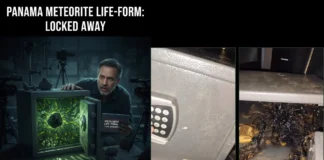
What if a backyard crash in Panama wasn’t just a rock from space but the key to unlocking hidden vaults of Earth’s forgotten experiments? That’s the urgent question gripping social media today, as a mysterious, tentacled entity—once contained in a safe—has been set loose into local waters. Videos show it pulsing and adapting like something out of a sci-fi nightmare.
The saga began on August 29, 2025, when Panamanian TikToker Kin, known online as @kinpanama, shared footage of a silver-gray meteorite that slammed into his backyard in the Pedregal district. Kin described a sudden crash that scorched nearby leaves, yet the potato-sized lump felt cool to the touch. Hours later, he claimed it cracked open, oozing a sticky green substance with a sharp, chemical burn smell.
That first video exploded, drawing millions of views and turning Kin’s modest account into a viral powerhouse with over 231,000 followers.
Progression of the Growth and Preservation
Kin’s videos tracked the entity’s rapid evolution over days. Day one brought the greenish algae-like ooze. By day two, it darkened into a viscous black goo that seemed to pulse and breathe.
Within a week, tentacles emerged, writhing in response to light, and the mass ballooned to the size of a small cat, snapping and reaching like a living thing. Kin nicknamed it “Galactic Seed” or “Venomkin,” evoking the Marvel symbiote for its inky, adaptive form. Worried about its explosive growth in daylight, he sealed it in a locked safe inside his hotel room closet, venturing in only for updates with basic dish gloves.
One clip even showed him freezing it, where it thrashed wildly, like a trapped animal desperate for escape. Despite the eerie movements, Kin handled it casually, skipping lab tests or hazmat gear, which only fueled online frenzy.
The 39-part TikTok series is built like a thriller, with dramatic edits and captions teasing “chilling updates.” Clips spread like wildfire to X, YouTube, and Reddit, racking up 10.9 million views on some posts. Hashtags like #PanamaAlien and #KinPanama trended globally, blending awe with doubt—fans compared it to “The Thing” or Venom, while skeptics spotted cuts hinting at staging.
Kin engaged lightly with theories but dodged live streams, and since TikTok doesn’t monetize in Panama, many chalked it up to pure buzz-chasing.
The Dramatic Release and Wild Adaptation
Around September 20, Kin dropped the bombshell: the entity had outgrown containment, becoming too erratic to keep. In raw footage, he carries the black mass to a nearby waterway and lets it slip in, where it immediately begins swimming with fin-like extensions, pulsing against the current in what looks like deliberate adaptation. “I let him go,” Kin captioned one video, hinting his posts had drawn dangerous eyes—perhaps authorities or thrill-seekers.
Enhanced clips show it “spotting” movements underwater, blending into the murk, but no verified public sightings have followed. The release clip alone hit millions of views, splitting audiences: believers see an alien thriving on Earth, while doubters call it a scripted exit to dodge scrutiny.
What the Elements Might Be
Dreams of an extraterrestrial breakthrough aside, the entity’s makeup points to earthly trickery over cosmic wonder. If legit, it could tie into panspermia, the idea of life hitchhiking rides on meteorites via hardy microbes or amino acids.
But breakdowns reveal a chemical sleight-of-hand: polydimethylsiloxane (PDMS), a flexible silicone polymer used in everything from cookware to implants, soaked in hexane, a fast-evaporating solvent. The mix swells PDMS into a fleshy blob; as hexane dries unevenly, it snaps and wiggles, faking breaths or grabs. Dyes likely added the black sheen and initial green tint.
This isn’t new—similar demos date back years, proving chemistry can mimic life without a spaceship.
X Users’ Wild Theories Add Fuel to the Frenzy
As the story hit X, conspiracy corners lit up with outlandish takes, turning debunkings into deeper lore. One standout came from Thunder Mutt (@JaredMutchler), who dropped a thread labeling the entity “Type-7 Fractalized Symbiote,” not an ET invader but a “bioplasmic seed” from a botched 1986 experiment via the “Montauk-Aurora Gate 3.” His post classified it as “Mireseed 7-Aquaform,” a sentient bio-AI hybrid triggered by water and electromagnetic vibes near Panama’s coastal “ley lines.” Core bits? Hyperadaptive nerve filaments in a carbon-silicate shell, with fragmented swarm consciousness that senses human fear via low-band EMF. Originally a “memory-seed carrier” for amphibious hosts, it malfunctioned into self-replication, now scanning for “resonance” to root and call backups.
“It’s a living vault key… old Earth tech seeded through dimensional bleed lines,”
He warned, noting suppressed sightings in Vietnam and the North Atlantic, and CIA tags as “skyjelly variant 4.” His sign-off? “I let him go = Activation Complete. Next time it returns, it won’t be alone.”
Other X voices piled on: @UAPWatchers echoed plasma-based origins with DARPA ties, warning of hive networks; @Truthpolex speculated on forced discrediting after Kin’s “entertainment” bio flip; and @BGatesIsaPyscho floated fungus hoaxes or real exogenic bugs.
Threads buzz with containment protocols and “what if it bonds?” fears, blending Montauk myths with black oil nods—pure internet alchemy keeping the myth alive.
Hoax or Harbinger? The Debate Rages On
For all the spectacle, red flags scream hoax: the “crater” hid matchstick burns, the rock mimicked painted Play-Doh, and edits screamed CapCut tricks. Kin’s bio once read “for entertainment only” before vanishing, and no officials or scientists have touched it. Reddit skeptics are echoing materials pros. They call it viral gold, not galactic.
Yet in a world hungry for wonder, the line blurs—hoax or not, Venomkin has us staring at our screens, wondering what’s next in Panama’s waters.
As of September 23, 2025, the entity swims free, Kin stays silent, and X theories multiply. But to us, it’s just another stunt to get the viral buzz and become famous for a fake reason.