

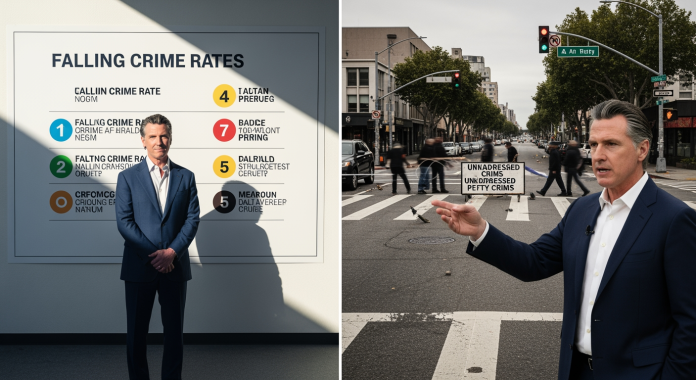
A key question looms over California’s public safety: Does the state’s reported “declining crime rate” reflect reality or an incomplete picture? Growing public concern and accusations of data manipulation, particularly in Los Angeles, challenge the narrative put forth by Governor Gavin Newsom’s administration.
Governor Newsom and his administration point to falling crime rates as evidence that criminal justice reforms are working. These initiatives often aim to reduce incarceration and address systemic issues, presented as clear progress. Yet, this official stance often conflicts with the daily experiences of many Californians, particularly in urban areas where residents express feeling less safe. The dispute centers on how these crime statistics are collected and interpreted.
Critic Kevin Dalton has become a prominent voice questioning the official data. He recently highlighted concerns on social media, citing incidents such as “hundreds of people take to the streets of Los Angeles, block intersections, hurt small businesses.” Dalton argues these events demonstrate a clear disconnect between official crime reports and daily life. This perspective suggests that some incidents may not be fully recorded or prosecuted, potentially skewing overall crime statistics and influencing public policy.
Gavin Newsom wants you to believe that crime is down in California. Here’s how that works: Hundreds of people take to the streets of Los Angeles, block intersections, hurt small businesses & consume insane amount of resources. No arrests No prosecutions Crime is down
— Kevin Dalton (@TheKevinDalton) December 22, 2025
A significant point of contention involves incidents that do not lead to arrests or prosecution. When events bypass the formal legal system, they may not appear in official crime reports. This reporting gap can obscure the actual state of public safety. In Los Angeles, for example, protests and public demonstrations that disrupt local businesses may not consistently factor into official crime data. This discrepancy creates a perception gap for residents and business owners who witness these events firsthand.
Criminologists and statisticians offer expert analysis, stressing the importance of data integrity and transparency in public safety reporting. They advocate for more detailed methodologies, including consistent definitions for crimes and public access to raw data.
These experts also recommend independent audits of crime statistics. Such audits would help ensure the data accurately reflect public safety and address concerns about potential bias, whether intentional or unintentional, in how information is collected and interpreted.
The debate over California’s crime statistics underscores a demand for greater transparency and accountability. It prompts state officials, including Governor Newsom, to directly address public concerns with clear explanations and accessible data. Effective public safety reporting relies on rigorous data collection, impartial analysis, and open communication. This commitment is essential for the public to trust the figures that guide policy and resource allocation.
