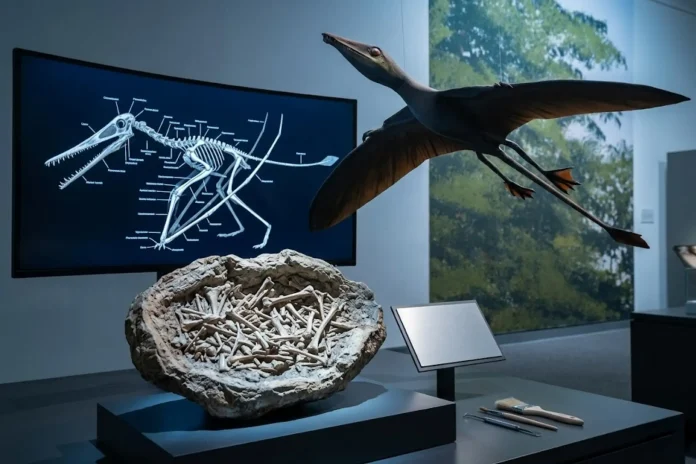
Scientists have identified a new species of prehistoric flying reptile preserved inside a fossilized vomit from more than 113 million years ago in Brazil. The specimen was first detected decades earlier as an unidentified calcareous concretion collected from the Romualdo Formation within the Santana Group of the Araripe Basin in northeastern Brazil. It remained stored unlabeled for years in the Museu Câmara Cascudo at the Federal University of Rio Grande do Norte until a team of Brazilian paleontologists reexamined the material in 2024.
The fossil was analyzed through detailed morphological comparison, tooth histology showing preserved dentine and pulp structures, and phylogenetic methods that confirmed its placement among ctenochasmatine pterosaurs. Senior author Aline M. Ghilardi of the Federal University of Rio Grande do Norte, working with colleagues including R.V. Pêgas from the Museu de Zoologia at the University of São Paulo and researchers from the Universidade Regional do Cariri, led the study. They formally named the species Bakiribu waridza in the 2025 paper, drawing the name from the indigenous Kariri language where bakiribú means comb and waridzá means mouth.
The creature features extremely elongate jaws with a rostral index of roughly 12 to 16, an exceptionally high tooth density of 17.6 teeth per centimeter, and an estimated total of 440 to 568 teeth arranged in a comb like pattern ideally suited for filter feeding on small prey in tropical waters. The regurgitalite form of the fossil also contained the remains of several small fish, providing direct evidence of predator prey interactions that likely involved a spinosaurid theropod. This discovery fills a previous gap in the fossil record for ctenochasmatid pterosaurs at low latitudes during the Early Cretaceous and was published on November 10, 2025 in Scientific Reports.
However, a 2026 study has proposed that the jaw like fragments are actually gill arch elements from a large bony fish, which could render the pterosaur classification uncertain and the name a nomen dubium. This reinterpretation, published in the Anais da Academia Brasileira de Ciências and available as a preprint here, highlights the challenges of working with isolated elements inside concretions. Such scientific debates ultimately strengthen paleontology by prompting additional histological and comparative research on similar museum holdings.
The significance of this find lies in the continued value of natural history collections, which allow researchers to revisit archived specimens with modern analytical techniques. In this instance the reanalysis not only proposed a new taxon but also opened fresh discussion on accurate identification within taphonomic contexts. The public response on social platforms has combined lighthearted comments about the vomit fossil with genuine interest in prehistoric ecosystems and evolutionary history. Verified details from Brazilian research institutions are available in official press materials, while broader context appears in popular science summaries.