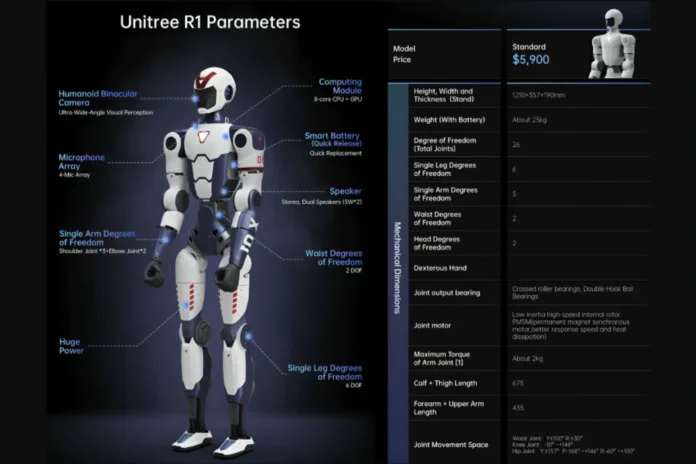
In the bustling halls of Shanghai’s World AI Conference on July 25, 2025, there stood a 4-foot-high, streamlined silhouette in the center of attention. The Unitree R1 humanoid robot cartwheeled its 25-kilogram frame with alien-like ease across the stage. Audiences stared in awe when it delivered a flawless spin kick and obligingly heeded a voice command with a nod of its head. This wasn’t a demonstration but a definitive statement of intention made by Hangzhou-based Unitree Robotics, which introduced the world’s lowest-cost humanoid robot that costs a nominal 39,900 yuan ($5,900). Basked in fame amidst techpowerhouses around the world, the event marked a turning point: robotics was no more a premium but in the realm of accessibility for developers and hobbyists everywhere.
The R1 is a marvel of engineering. Weighing 55 pounds and standing 4 feet tall, it has 26 joints that in robotics are called “degrees of freedom,” the number of ways in which its limbs are able to move on their own. This enables graceful motion like cartwheels, handstands, and running downhill. With 8-core CPU and GPU, the R1 includes multimodal AI, so it will process voice commands and recognize images with its binocular camera and 4-mic array. It has clear-sounding stereo speakers and a quick-release battery with up to an hour of runtime but no delicate fine-finger dexterity to process fine work like moving small items.
“It’s a platform for developers to build on, not a butler yet,”
noted tech analyst Deedy Das on LinkedIn, highlighting its potential for research over immediate household use.
The R1’s viral demo videos sparked a frenzy online, amassing millions of views. Yet, not everyone was convinced. Reddit threads buzzed with debates over whether the robot’s acrobatics were CGI-enhanced, “Can it vacuum? Can it cook?” one YouTube commenter quipped, reflecting widespread skepticism about its practical utility. Others raised concerns about surveillance risks or potential military applications, given Unitree’s ties to China’s AI ecosystem.
The R1’s price cheaper than a maxed-out MacBook Pro sets a new benchmark. Unitree’s earlier models, the G1 ($16,000) and H1 ($90,000), pale in comparison, while competitors like Tesla’s Optimus ($20,000 projected) and Boston Dynamics’ Atlas (over $200,000) remain out of reach for most. The global humanoid robot market, valued at $2.4 billion in 2023, is projected to hit $24 billion by 2032, per SkyQuest, and the R1’s affordability could accelerate this growth. China’s push, backed by government support, signals its ambition to lead in “physical AI” robots that merge generative AI with real-world mobility. This challenges Western firms, who lag in cost efficiency despite advanced designs.
A tweet from X.
Unitree’s R1 is a leap toward democratizing robotics, but hurdles remain. Its one-hour battery life and lack of gripping ability limit immediate consumer applications. Regulatory questions loom, particularly around privacy and safety standards for home use. Unitree’s recent IPO filing suggests confidence in scaling production, potentially flooding the market with affordable units. As Wang Xingxing, Unitree’s CEO, stated at the Shanghai summit,
“We’re not just making robots; we’re inventing a future where they’d be in every home and every office.”
Whether the R1 will be a household name or a programmers’ haven, its debut pronounces a reality: the era of cheap humanoid robots has arrived, and it’s spearheaded by China.