

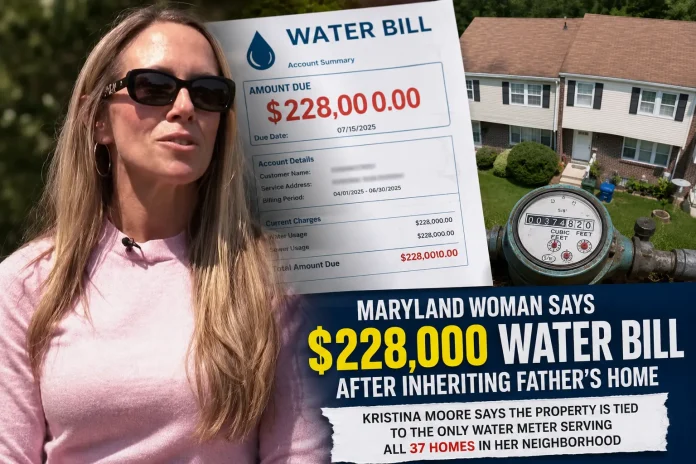
Kristina Moore thought inheriting her late father’s townhome in Northeast Baltimore would be a straightforward family matter. Instead, she’s now staring down a staggering $228,000 water bill that has left her fighting both the city and her homeowners association.
Moore, a Morgan State University graduate working in the city, discovered the massive debt in April 2026 after finding a shut-off notice on the door of the Springwood Estates property. The warning threatened to cut water service within 45 days unless the balance was paid in full.
The root of the problem? An unusual shared utility setup in the 37-townhome Springwood Estates community, built in the 1970s. All homes are served by a single master water meter, but the billing account is registered solely to Moore’s inherited address. That means her property is legally on the hook for the entire neighborhood’s water usage and decades of accumulated shortfalls.
“I feel let down by the city,” Moore said. “This is my childhood home… I think it’s sad.” She added that the lien now attached to the home has effectively rendered it unsellable.
Under the typical arrangement in the Springwood Estates Homeowners Association, residents pay their individual shares to the HOA, which is supposed to handle the master bill to Baltimore City’s Department of Public Works. But years of discrepancies — unpaid or underpaid amounts — snowballed into the six-figure total now pinned to Moore’s property.
Moore reached out to the HOA and provided copies of the association’s own covenants indicating it should manage the payments. Her realtor, Lisa Ciofani, joined her at DPW offices to review lien documents, but city officials held firm: the lien stays until the full debt is cleared. A payment plan involving the HOA is in place, yet it hasn’t lifted the restrictions on the property.
HOA President Regina Johnson acknowledged that the association collects from residents and pays the water bill but offered no clear explanation for how the massive balance built up. Neighbors voiced disbelief at the situation, with one telling local media, “It makes no sense. We should all have our own bills.”
Moore and her team have engaged city leaders, including an advisor from Baltimore City Council President Zeke Cohen’s office. Early optimism in May about potentially removing the lien faded by early July, with the debt and restrictions still hanging over the home.
The Department of Public Works has been tight-lipped, declining detailed comment and citing privacy rules under the Maryland Public Information Act. Questions about the master meter setup and how billing responsibility ended up tied to a single-family address remain unanswered.
Master meters aren’t unheard of in condo and townhome associations for efficiency reasons, but linking full liability to one address in this manner has turned a family inheritance into a financial nightmare. Similar disputes have popped up in other shared-meter communities, though rarely on this scale.
As of mid-July 2026, the story — first reported by local outlet WBFF (FOX45) and picked up nationally — continues to develop. Moore is pushing for a resolution, but no final outcome on the lien, potential legal action or broader fixes has been announced.

