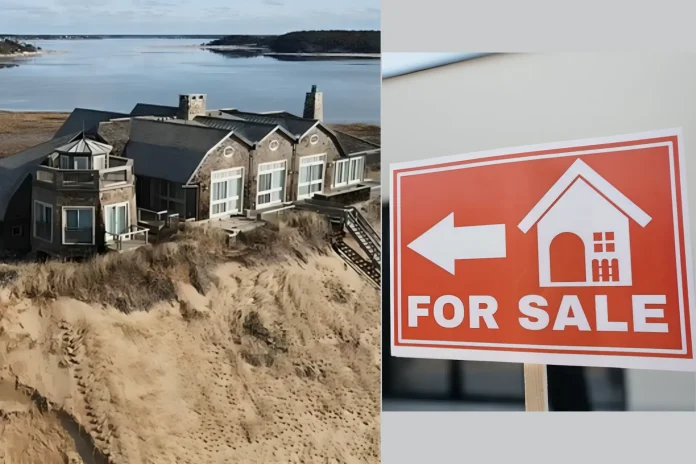
A retired New York attorney is taking JPMorgan Chase to federal court, arguing he should not have to repay a $3.85 million mortgage on a luxury Cape Cod mansion because he was in the midst of a manic episode from Bipolar I disorder when he bought it.
John G. Bonomi Jr., aged 66, bought the 5,817 square foot house located at 1440 Chequessett Neck Road in Wellfleet, Massachusetts for the total asking price of $5.5 million in November 2021. The land adjacent to Cape Cod Bay and prone to erosion is called Blasch House. Bonomi funded the house with the help of Chase and paid monthly installments of $21,053 until he stopped paying in September 2024.
The mansion was torn down in February 2025 for an estimated cost of $250,000 because of the threat of falling into Cape Cod Bay and damaging the environment of the neighboring shellfish beds. The land eventually lost its value and became worth only $385,000.
In his lawsuit, which was filed in the United States District Court for the Southern District of New York in October 2025, Bonomi argues that he was not of sound mind when he signed the contract.
“Plaintiff was acting under an uncontrollable manic psychosis at the time he entered into the Mortgage and Note,”
The filing states.
“It is a recognized diagnostic fact that a symptom of bipolar disorder is irrational risk-taking and impulsive behavior, including reckless spending.”
He argues no rational buyer would have paid full price for the property, given the well-known erosion risks of 3.8 to 5.6 feet or more per year. Bonomi alleges the bank “took unconscionable advantage of his condition” and “willfully avoided acknowledging” warning signs, including his planned retirement. He seeks to void the remaining debt, plus interest, over $1.4 million in damages, and attorney’s fees.
JPMorgan Chase has denied the allegations. The bank maintains it followed standard lending practices and disputes any responsibility for assessing an undisclosed mental health condition. Legal experts note that while New York law can sometimes void contracts due to incapacity, proving it and that the lender should have known is a high bar. Fordham Law professor Ethan Leib told the Boston Globe that Bonomi faces a “difficult burden of proof.”
The case highlights bigger issues. Coastal erosion driven by climate factors threatens high-value waterfront properties nationwide. In Wellfleet, previous owners fought unsuccessfully for a seawall, denied under wetlands protections. Bonomi tried similar measures before the demolition.
It also brings up issues regarding the mental health aspect of making financial decisions and the responsibilities of creditors. Bonomi, who was diagnosed with Bipolar I Disorder in 2009, was formerly an attorney and an ADA.
This particular incident has attracted a lot of national attention because of the combination of all these elements that make it a fascinating story. No court has ruled yet. The outcome will hinge on evidence presented as the case moves forward, likely into 2026. For now, Bonomi remains on the hook for the mortgage on a house that no longer exists unless a judge sees it differently.