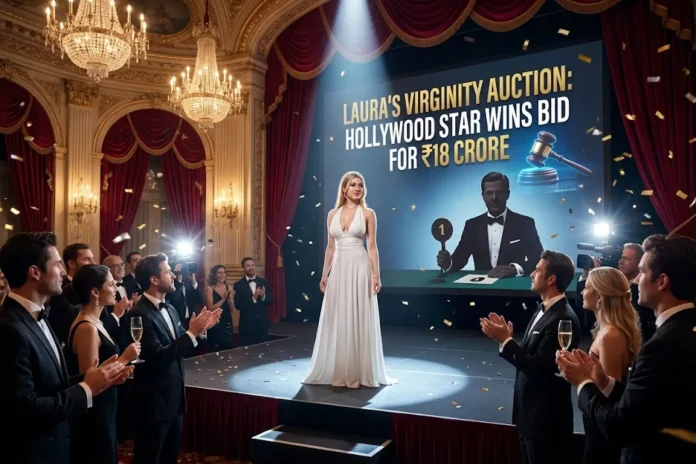
A 22-year-old British student named Laura auctioned her virginity through a controversial escort agency, securing a winning bid of approximately 2 million euros from an anonymous Hollywood actor, a transaction that has sparked intense ethical debates worldwide. Facilitated by Germany’s Cinderella Escorts, the process began when Laura submitted her application in December 2023, leading to exclusive events where she met potential buyers from elite circles, including politicians and businessmen. The auction culminated in a private encounter at a luxurious five-star hotel in London, where the buyer arranged for a doctor to verify her virginity before proceeding, ensuring the terms were met under the agency’s oversight. Laura, described as a rational and independent young woman from a strict religious family in Manchester, viewed the decision as a strategic move to achieve financial freedom, funding her university studies, property investments, and travel without the burdens of traditional employment or relationships that might not last.
Details from the agency’s official profile reveal Laura as a blonde, green-eyed individual standing at 162 cm and weighing 53 kg, with natural features and no tattoos or piercings, though reports consistently list her age as 22 during the 2025 events, contrasting with the site’s listing of 18, which may reflect an entry age or a discrepancy warranting further scrutiny. The bidding war was fierce, with the Hollywood actor from Los Angeles outbidding a London politician, a Dubai businessman, a Geneva entrepreneur, and a Berlin rapper, according to both media accounts and the agency’s records. Laura’s post-auction statement emphasizes her satisfaction, noting the overwhelming experience of high-profile interest and her initial hesitation upon learning of the buyer’s past visit to Jeffrey Epstein’s Little Saint James island, a detail that nearly led her to withdraw but ultimately did not deter her. She has since expressed no regrets, highlighting how the money has enabled a dream life, including aspirations to become a sugar baby supported by wealthy patrons.
Public backlash has been swift and divided, with social media erupting in discussions that garnered millions of views across platforms, including over 930,000 on initial X posts and viral Instagram reels exceeding 100,000 likes. In India, where the story gained massive traction after the rupee was converted to 18 crore, reactions often invoked cultural contrasts, from Kaliyuga references to critiques of Western individualism, blending outrage over perceived exploitation with defenses of personal autonomy. Sentiment remains mixed, with roughly 40 percent negative views focusing on moral decay and power imbalances, 30 percent positive endorsements of empowerment, and the remainder neutral debates on consent in monetized intimacy. Recent X discussions in January 2026 show the story resurfacing, with users sharing images and speculating on the actor’s identity, though no confirmations have emerged.
Authenticity checks reveal the story’s widespread coverage by outlets like NDTV and Hindustan Times, alongside the agency’s direct confirmation of the sale on their site, including Laura’s verbatim quotes that align with interviews. However, virginity auctions have a history of skepticism, as noted in broader contexts where similar high-profile cases, such as those of Natalie Dylan or Catarina Migliorini, were later revealed as uncompleted or promotional stunts. No explicit debunkings appear in fact-check searches, but the lack of independent verification beyond the agency’s claims and tabloid-style reporting raises questions about potential exaggeration for publicity, a tactic Cinderella Escorts has employed in past controversies.
As a seasoned journalist covering human-interest stories with ethical undercurrents, this case exemplifies the commodification of personal milestones in a digital age, where economic pressures collide with societal norms, potentially empowering individuals like Laura while exposing them to exploitation. The Epstein connection, verifiable through public flight logs, adds a layer of intrigue, suggesting deeper ties between wealth and controversy that merit ongoing investigation. Regulators might soon scrutinize such platforms, as seen in evolving laws around sex work in Europe, to protect participants without stifling choice. For now, Laura’s narrative stands as a provocative testament to agency in an unequal world, but readers should approach with caution given the genre’s track record.