

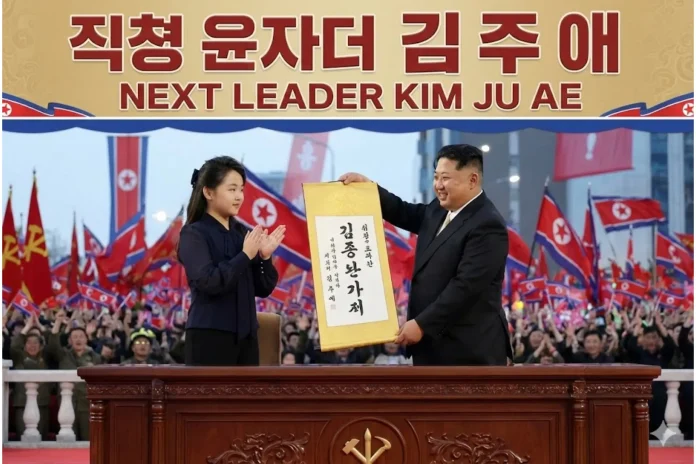
North Korean leader Kim Jong Un has positioned his 13-year-old daughter, Kim Ju Ae, as his designated successor, according to a fresh intelligence assessment that signals the extension of the Kim dynasty into a fourth generation. This revelation emerged from a closed-door briefing by South Korea’s National Intelligence Service to lawmakers on February 12, 2026, where officials highlighted her evolving role in state affairs. The move emphasizes the regime’s focus on bloodline continuity, even as it navigates health speculations surrounding Kim Jong Un and heightened international scrutiny.
The news broke through statements from South Korean lawmakers like Lee Seong-kweun, who relayed the NIS’s upgraded evaluation after the session in Seoul. Previously described as in “successor training,” Kim Ju Ae is now viewed as having entered the “designated successor” phase, based on observable indicators from North Korean state media and events. This intelligence-driven disclosure underscores how information about North Korea’s opaque leadership often surfaces via external monitoring rather than official announcements from Pyongyang.
Kim Jong Un has indicated this succession indirectly through his daughter’s prominent placements at key public events, rather than through explicit declarations. For instance, she has accompanied him to military parades, weapons tests, and symbolic visits, such as to the Kumsusan Palace of the Sun, which honors the Kim family legacy. These appearances, coupled with protocol that treats her as the de facto second-in-command, demonstrate a calculated effort to build her authority within the regime’s hierarchical structure.
Born in 2013 to Kim Jong Un and his wife Ri Sol Ju, Kim Ju Ae made her public debut in November 2022 during an intercontinental ballistic missile launch, marking the start of her visibility in state propaganda. Since then, she has joined her father at diverse occasions, including factory inspections and a high-profile trip to Beijing in September 2025 for a summit with Chinese President Xi Jinping. North Korean media often refers to her as the “respected daughter,” a term that elevates her status and hints at her grooming for leadership.
Adding intrigue to her profile, intelligence reports note signs that Kim Ju Ae has begun offering input on policy matters, transitioning from a symbolic figure to one with emerging influence. If confirmed at the upcoming Workers’ Party Congress, she could receive a formal title like first secretary, potentially making her the first female leader in North Korea’s history. This development raises questions about gender dynamics in a traditionally patriarchal society and how her youth might shape future diplomacy.
The accompanying image from recent coverage shows Kim Ju Ae standing beside her father at a public rally, both dressed in formal dark attire amid a sea of waving North Korean flags. In the photo, she claps politely with a composed expression, while Kim Jong Un waves smilingly to the crowd, capturing a moment of familial unity at a state event. Such visuals, released through official channels, serve to humanize the leadership and reinforce the dynasty’s narrative to both domestic audiences and international observers.
This succession plan reflects broader challenges in isolated regimes, where personal loyalty often trumps institutional reforms. While it ensures short-term stability, it could complicate relations with allies like China and adversaries in the West, especially if Kim Ju Ae’s inexperience leads to unpredictable policies. Analysts suggest this choice prioritizes regime survival, prompting ongoing monitoring of North Korea’s internal power shifts.
For historical context on the Kim family, review the Korean Central News Agency archives. Details on the intelligence briefing appear in Yonhap News Agency coverage. Broader implications for East Asian security are outlined in U.S. State Department briefings on North Korea. Additional perspectives on dynastic politics can be found through Radio Free Asia analyses.

