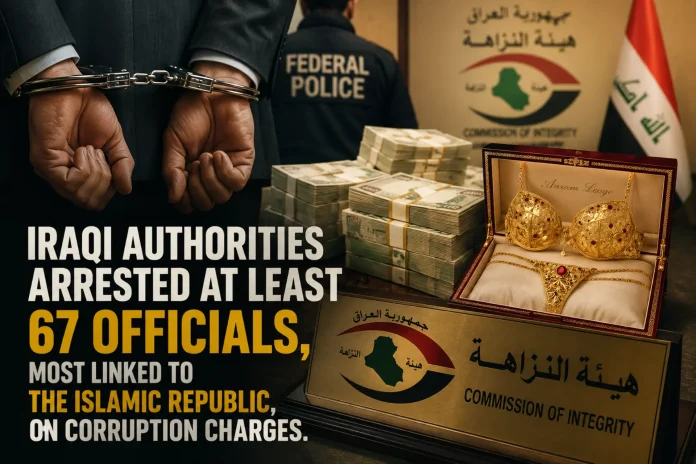
Iraqi security forces executed coordinated raids across Baghdad in late June that led to the arrest of dozens of officials with reported connections to Iranian networks on corruption charges, while recovering substantial amounts of cash and gold items from the home of parliament member Aliya Nasif.
The operation formed part of Prime Minister Ali al-Zaidi‘s broader anti-corruption drive that began after he took office in May 2026. It accelerated following statements from a previously detained former deputy oil minister whose testimony implicated a network of politicians and bureaucrats in the diversion of public funds, particularly through oil sector irregularities. Judicial authorities issued arrest warrants that targeted entrenched graft networks, many of which involved figures aligned with Shia political groups maintaining close regional ties.
Elite units from the Counter Terrorism Service carried out the raids in the early morning hours of June 28, focusing on residences inside Baghdad’s heavily fortified Green Zone and additional sites. Security teams sealed entrances to the district and conducted methodical searches based on prior intelligence gathered from earlier detentions. The effort expanded in the following days, with additional arrests bringing the total number of detainees to at least 67 according to updated reports, as authorities pursued suspects who had attempted to flee.
Investigators recovered more than 20 billion Iraqi dinars, equivalent to approximately $15.5 million in cash, along with quantities of gold from the residence of MP Aliya Nasif. Her son, who previously served as chief of staff to a former prime minister, was also detained during the search of the property. Broader sweeps across multiple locations yielded tens of millions more in currency, foreign exchange, and valuables. Social media quickly circulated images of large cash bundles and, among the seized items, a gold-colored lingerie set presented in a decorative box, though some fact-checkers have flagged the authenticity of specific photographs as unverified.
Other prominent figures taken into custody included Azm Alliance leader Muthanna al-Samarrai, several sitting parliamentarians such as Hind al-Abbasi and Ziyad al-Janabi, as well as Deputy Oil Minister Ali Maarij. The seizures highlighted patterns of wealth accumulation by political elites who maintained public personas of piety and resistance while amassing resources that could have supported public services. Ordinary Iraqis expressed cautious optimism that recovered assets might eventually return to state coffers, though skepticism remained about whether the campaign would extend to higher levels of the political structure.
These developments challenge longstanding claims that external sanctions alone prevent meaningful investment in citizen welfare across the region. Internal corruption within cross-border political networks appears to have diverted significant resources into private hands, creating visible symbols of excess such as the gold items recovered during the operation. The raids underscore the difficulties facing efforts to build accountable institutions in Iraq, where alliances and influence operations have long complicated transparency measures.
Authorities indicated that investigations remain active, with further detentions and asset recoveries expected in coming weeks. The case has drawn attention to financial flows between Iraq and neighboring countries, raising questions about how such networks sustain political influence at the expense of domestic development priorities. Sustained legal follow-through will determine whether the operation produces lasting reforms or remains limited to high-profile actions.