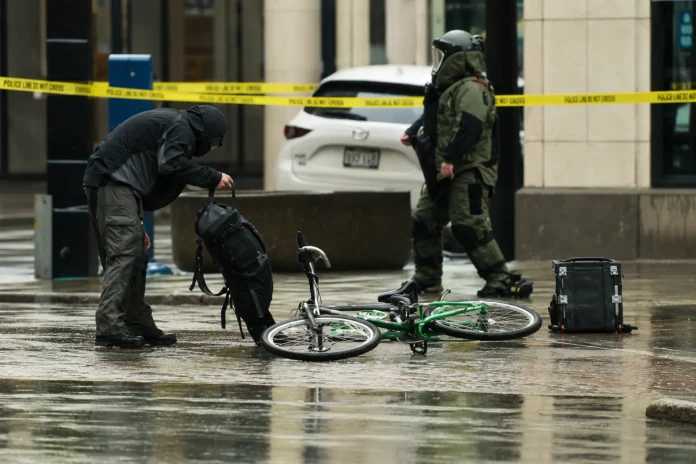
On a rain-slicked downtown Milwaukee street on May 21, 2018, the air felt heavy with caution. Yellow police tape fluttered in the breeze around a gray-and-black backpack sitting atop an electrical box at the corner of West Wisconsin Avenue and North Plankinton Avenue. A bomb squad technician in a thick, padded protective suit moved slowly and deliberately, kneeling beside the suspicious package while officers kept a wide perimeter. The scene carried the quiet, tense intensity of professionals doing dangerous work the only way they knew how, with steady, careful precision.
Then a local man on a bicycle rode straight through the tape.
What happened next unfolded in seconds but felt much longer to everyone watching. Matthew Hughes, then 39, a Milwaukee resident, had seen the news coverage from nearby and grown visibly frustrated with how long the process was taking. He pedaled up, ignored repeated commands to stop, dropped his green bicycle on the wet pavement, and bent over the backpack. In one quick, almost defiant motion he unzipped it and shook out its contents, clothing, water bottles, and other everyday items, scattering them across the street. The tension that had built during the careful examination broke instantly. His actions mirror other tense bomb-squad response standoffs that have played out under public scrutiny, where civilian impatience meets professional protocol.
Officers reacted immediately. Multiple law enforcement personnel rushed forward in a coordinated surge. They brought Hughes to the ground with force, their bodies piling on as he went down near a concrete planter and the side of a building. The green bicycle lay on its side a few feet away. The entire sequence, captured on news video, lasted less than 30 seconds from the moment he reached the bag until he was restrained on the pavement. What had been a methodical, almost solemn operation turned into sudden, physical chaos.
Hughes later told investigators he acted because he wanted to protect people. He believed that if there truly was a bomb, any explosion would send shrapnel toward him instead of bystanders. He had watched the slow, deliberate work of the bomb squad from a distance and simply ran out of patience. In his mind, he was stepping up for his city. To the officers on scene, he had just crossed into an active investigation zone and potentially contaminated evidence or triggered an unknown device.
The video of that moment resurfaced this week and quickly spread across social platforms, amassing millions of views. People watching today feel the same mix of emotions the original footage provokes: the frustration of waiting through long emergency responses, the shock of seeing a regular person take such a risk, and the visceral impact of watching officers tackle him once the bag was already open and clearly harmless. The wet street, the heavy protective suit, the sudden rush of bodies, all of it feels raw and human when you watch it unfold. The pattern echoes a separate bomb-disposal callout in Toulouse, where unusual explosives drew specialized units into a confined public space.
Hughes faced charges of disorderly conduct and obstructing an officer. He pleaded not guilty in court, and the case moved toward a deferred prosecution agreement. Public records show authorities treated the incident as a clear case of interfering with an active response, even though the backpack ultimately contained nothing dangerous.
The widely shared clip, originally recorded by local news crews, shows the full sequence in roughly 29 seconds: the bomb technician walking away from the bag, Hughes approaching and emptying it, and then the immediate physical response from officers. The footage captures both the quiet professionalism of the initial response and the sudden intensity of the confrontation that followed.
This incident continues to spark conversation because it sits right at the uncomfortable intersection of two very human instincts. The first is the desire to help and make things move faster when danger feels close. The second is the trained discipline required when lives could genuinely be on the line. Hughes acted out of care for his community. The officers acted to protect the scene, their team, and the public. Both sides operated from real, understandable motivations, a pattern that surfaces whenever civilians step forward in crisis moments without waiting for official direction.
The case remains available for review through official Wisconsin court records. Details on how authorities handle suspicious packages can be found through established public safety reporting from the time. Hughes shared his perspective directly with investigators, and those accounts align with the sequence shown in the video.
Years later, the footage still resonates because it shows real people making split-second decisions under pressure. It reminds us that even when intentions are good, stepping into an active emergency response carries consequences. And it captures, in those brief, intense moments on a wet Milwaukee street, the complicated reality of public safety work and the people who sometimes feel compelled to get involved anyway.