

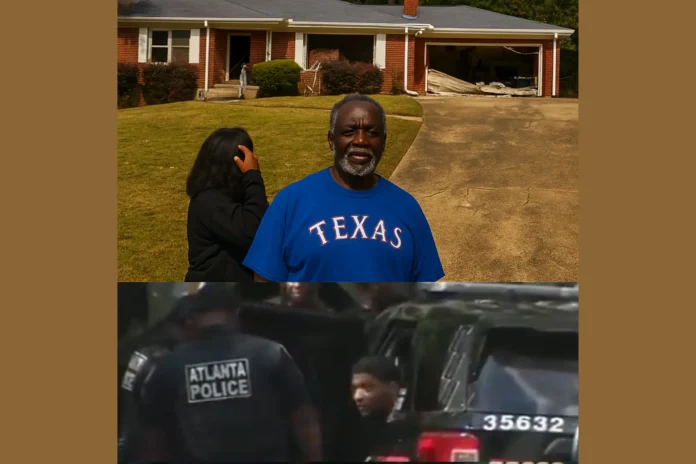
One ordinary landlord in southwest Atlanta never imagined his rental property would become the scene of a high-stakes manhunt that left his front door in splinters and his garage door in ruins.
Richard McQueen arrived at his home on Honeysuckle Lane near Campbellton Road on October 8, 2025, after a frantic call urged him to check things out. He walked into chaos: shattered windows, walls punctured by heavy tools, and gas canisters scattered like forgotten party favors. Officers from the Atlanta Police Department had just wrapped up a tense three-hour standoff, all to nab Derrick Groves, a 28-year-old fugitive who had slipped away from a New Orleans jail five months earlier.
McQueen, who relies on steady rent checks to keep things afloat, stood there shaking his head. His daughter handled the collections, and he admits he barely knew the faces behind the payments.
“I just collect rent. I ain’t never knew who was in there,”
He said, his voice trailing off as he surveyed the wreckage. For McQueen, this was not just about busted doors but about trust shattered in a neighborhood where folks already feel the pinch of rising costs and unexpected hits.
Groves, convicted of two counts of second-degree murder from a deadly 2018 shooting during Mardi Gras festivities, had been the last loose end from a bold breakout at the Orleans Parish Justice Center on May 16, 2025. He and nine others clawed through a hole behind a toilet, hopped a barbed-wire fence, and vanished into the night, taunting guards with a carved message on the cell wall. The Orleans Parish Sheriff’s Office launched a massive search, but Groves dodged tips and trails across states until a hotline call from New Orleans pointed teams straight to this Atlanta hideout.
The raid kicked off that morning when SWAT surrounded the house, backed by Clayton County K-9 units and U.S. Marshals Service deputies. Groves hunkered down, ignoring pleas to come out peacefully. Teams fired gas rounds into the home and basement to flush him, then sent in a dog that sniffed him out in a cramped crawl space. Shirtless and handcuffed, he emerged grinning, even blowing a kiss to news cameras before a patrol car whisked him away. No shots fired, no one hurt, but the house? It looked like it had lost a fight with a wrecking ball.
Neighbors on Honeysuckle Lane peeked from behind curtains, hearing pops from the gas and the thud of rams against walls. One resident wondered aloud how a New Orleans escapee ended up in their quiet corner of the city, maybe tipped off by a fresh argument with someone close. Inside, officers found drugs and guns, hints of a deeper web that investigators are still untangling.
As Groves faces extradition back to Louisiana for escape charges on top of his life sentence, McQueen grapples with the bills piling up. Who foots the tab for a raid gone right but a home gone wrong?
In Georgia, these situations often leave owners like him navigating a maze of claims against local and federal agencies, with payouts far from guaranteed. Recent fights over botched FBI raids in Atlanta underscore this grind, where families push for accountability through courts that sometimes drag on for years. One ongoing Supreme Court case spotlights an innocent household hit hard by mistaken entry, reminding us that justice for fugitives should not come at the unchecked expense of everyday people. McQueen’s story adds a raw edge to that debate: in the rush to catch the bad guy, how do we protect the good ones caught in the crossfire?
This hits home for families juggling rentals in tight-knit spots like Campbellton. It sparks real talk about screening tenants smarter in an era of hidden dangers, while pushing for more explicit rules on raid repairs. McQueen plans to file his claim soon, hoping for a resolution that lets him rebuild without the heartbreak.
