This is what was unveiled on December 1, 2025, in the heart of a busy crossroads in eastern China. The big city of Hangzhou in Zhejiang Province, with its more-than-12-million folks buzzing all around, launched this AI robot named Hangxing No. 1 or Officer HJ001 in short form. It’s designed to help direct traffic and keep things moving smoothly. This is a component of the large 2025-2027 plan for “embodied AI” coming from the city, which comprises 17 different projects for weaving robots into everyday life within the city. It’s also tied to China’s broader effort to build “smart cities” that use tech to fight off the chaos of traffic jams in these exploding urban areas.
A tweet from X.
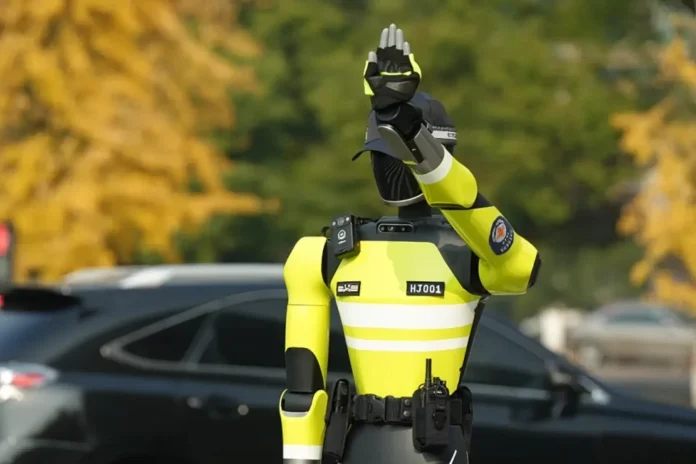
The thing’s about 1.85 meters tall, decked out in a bright yellow-green vest with those shiny police stripes, a helmet, and it rolls around on four wheels.
“It can do 12 different gestures that look just like what a human cop would do stop, go straight, turn left, that sort of thing,”
Said Zhang Wanzhe, a traffic officer from the Binjiang brigade, according to a local news bit. Hangxing No. 1 has 4K cameras and millimeter-wave radar giving it full 360-degree vision, so it can catch stuff like people jaywalking, scooter riders without helmets, or cars sneaking over lines. When it spots trouble, it lets out a loud whistle or speaks up in polite Mandarin, like
“Hey, please put on your helmet” or “Stick to the crosswalk, okay?”
It links up with the traffic lights, sends proof of violations straight to the police database, and for now, it’s in trial mode with a real officer hanging nearby to oversee things.
A quick 30-second clip posted on X by @jacksonhinklle on December 2 blew up online, showing the robot doing its thing at the corner of Binsheng Road and Changhe Road in Binjiang District. The video captures your everyday city vibe lanes jammed with cars, vans, scooters, and people weaving through, with fall leaves on the trees and tall buildings looming. You see the robot spinning on its base, sticking out its arms to stop traffic at reds, signaling drivers to go on greens, and blasting that whistle to make sure everyone halts. There’s even a part where it tilts its head at someone who might be breaking the rules, really driving home how it’s watching everything in real time at a spot that sees about 60,000 vehicles a day.
People’s takes on it are all over the place some are thrilled, others wary. In China, Hangzhou officials say early numbers show folks following the rules jumped from 82% to 97% where it’s stationed.
“Our traffic squad’s getting a brain upgrade,”
The city’s tourism folks posted on social media. Around the world, it’s stirring up the usual talks we’ve heard in the West: worries about cops losing jobs, privacy getting invaded by non-stop cameras, and whether people would even listen to a robot barking orders. One X commenter joked,
“You gonna obey that thing?”
But a 2023 study from IEEE backs up the upsides, saying robots like this could cut city traffic snarls by as much as 20%.
This isn’t coming out of nowhere China’s been tinkering with robots for years, like those wheeled ones in Handan back in 2019 or the humanoid experiments in Shanghai this year. It connects to Hangzhou’s “City Brain” setup from Alibaba, which has seriously dialed back congestion since 2019. Other countries dealing with clogged streets and overworked police might be watching this closely, weighing the efficiency gains against the ethical headaches in handing over public spaces to machines.
In the end, Hangxing No. 1 feels like a glimpse into a future of cities where the robots do the boring stuff the people can focus on the trickier parts-only if we build in enough trust and checks to make sure it doesn’t go off the rails.