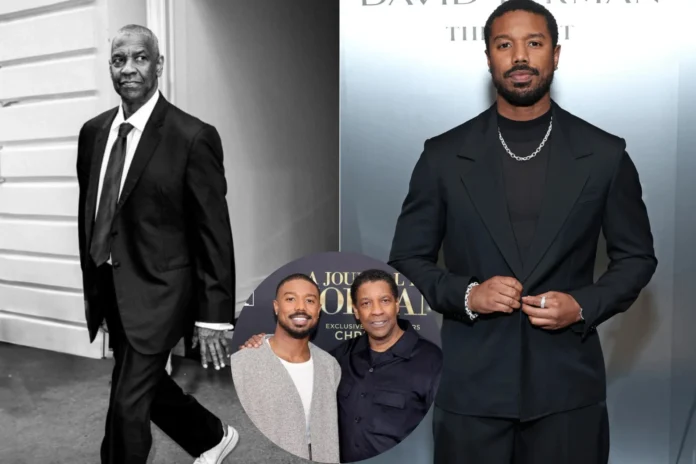
In a recent cover story with New York Magazine (via Vulture), actor Michael B. Jordan, celebrated for his roles in Sinners and A Journal for Jordan, opened up about career-shaping advice he received from legendary actor and director Denzel Washington. Washington, who directed Jordan in the 2021 film A Journal for Jordan, offered guidance on managing fame in today’s digital landscape, urging the younger star to limit his social media presence to avoid overexposure and sustain audience demand for his on-screen work.
Washington’s counsel was both practical and pointed. He posed a rhetorical question to Jordan:
“Why would they pay to see you on a weekend if they see you all week for free?”
Jordan took this advice to heart, noting that his reserved approach to social media aligns with his personality and adds to his mystique. He mentioned,
“It works for my personality because I don’t like sharing a lot anyway. So, I found that me just being myself in that type of way adds to the mystique—wanting to find out what [I’m] up to.”
Jordan, who counts Washington as a significant inspiration, has embraced this philosophy wholeheartedly. Unlike many peers, he steers clear of platforms like X and TikTok. On Instagram, where he boasts 25 million followers, his posts are sparse and typically limited to promotional content tied to film releases. This deliberate restraint reflects a strategic effort to keep his personal life private and professional appearances special.
The bond between Denzel Washington and Michael B. Jordan deepened during their collaboration on the 2021 film A Journal for Jordan, where Washington directed Jordan. With decades of experience in Hollywood, Washington recognized the risks of overexposure in an era dominated by social media.

He shared his insight with Jordan at a pivotal moment in the younger actor’s career, as Jordan transitioned from TV roles in The Wire and Friday Night Lights to a leading film star. Washington’s advice was simple yet profound: limit public exposure to preserve mystique and ensure long-term viability. Rooted in the economics of scarcity—where rarity increases value—this counsel drew from the classic playbook of movie stardom, tailored for a modern context.
The proof of Washington’s advice lies in Jordan’s results. Sinners, directed by frequent collaborator Ryan Coogler, raked in over $350 million globally, showing that limited social media doesn’t dent box office draw. Jordan’s partnerships with Coogler—spanning Fruitvale Station, Creed, and Black Panther—have consistently delivered critical and commercial wins. Jordan’s upcoming directorial debut, a Thomas Crown Affair reboot, further cements his trajectory, suggesting his focus on craft over digital chatter enhances his appeal to filmmakers and audiences alike.
Jordan’s success questions the sustainability of constant online engagement. In a digital world where oversaturation risks audience fatigue, his strategic absence echoes the controlled scarcity of old Hollywood—think rare interviews and curated appearances. This challenges the idea that likes and follows equal career success, proposing instead that mystique can drive demand more effectively. It also reflects a cultural pushback against the commodification of personal life, offering a model for stars who value privacy over publicity.