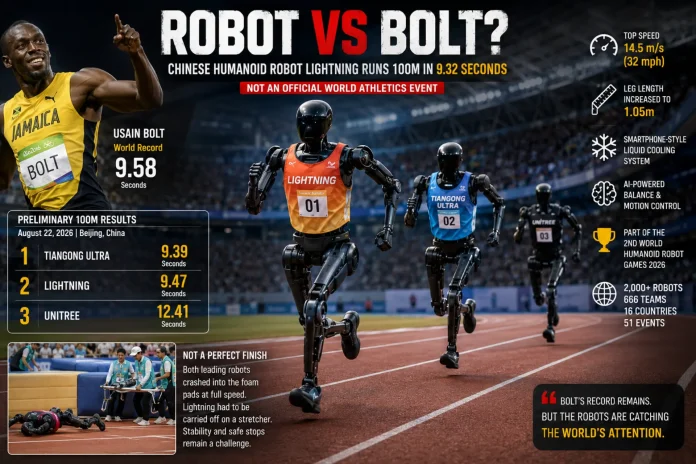
But wait, is that a robot beating Usain Bolt in a race? There have been some videos on social media showing a Chinese-made humanoid robot called Lightning racing on a track, apparently setting the time of 9.32 seconds to complete the 100 meters run. That means he finished 0.26 seconds faster than the current fastest human runner the Jamaican Usain Bolt.
Hold on. The number is real, according to Chinese state media and confirmed in reporting by Reuters and other outlets. But it came from a preparatory test, not an official World Athletics competition. Bolt still holds the recognized human record.
The test was conducted during the period preceding the commencement of the second World Humanoid Robot Games in Beijing, on August 22, 2026, in the National Speed Skating Oval. Honor, which is a Chinese manufacturer of smartphones, had built Lightning. The highest speed reported was 14.5 meters per second or 32 mph. They had increased the leg length from 0.95 meters to 1.05 meters after winning a half-marathon.
On that particular day during the real-life prelims, another Chinese competitor called Tiangong Ultra from Beijing Humanoid Robot Innovation Center won in 9.39 seconds. Lightning came second in 9.47 seconds. Both robots ran faster than Bolt’s record time. The third to cross the line was Unitree which had a time of 12.41 seconds.
This was no overnight jump. At the inaugural games in 2025, the same Tiangong Ultra platform won the 100 meters in 21.50 seconds. The improvement in one year is massive. Lightning had already made waves earlier in 2026 by winning a humanoid half-marathon in Beijing in 50 minutes and 26 seconds, a pace faster than the elite human men’s world-record mark.
The Games themselves were huge: more than 2,000 robots from 666 teams across 16 countries competed in 51 events, from sprinting and football to dancing and industrial tasks. Rules stressed full autonomy remote control was heavily restricted. China is pouring resources into humanoid robotics as a strategic industry, aiming at manufacturing, logistics, and everyday applications while the technology race with the United States intensifies.
Yet the race was not won by those who placed first. Both of the victors missed the target by several feet at full speed and crashed into thick foam pads at the end of the course. Tiangong Ultra almost went out of bounds. The second-placed robot, Lightning, was lifted off the ground on a stretcher. Dynamic motions, stability, and safe halts are definitely areas of opportunity. The robots are undoubtedly capable of breathtaking speeds under controlled conditions, but they are still being refined to be graceful and reliable machines.
As an American, it is disheartening to see the technological superiority of the Chinese state. Their actuators, thermal regulation systems (Lightning used a smartphone-style liquid cooling system), balance algorithms, onboard AI, and even their business models were being rapidly advanced by Chinese labs and companies. The race provided Americans with exciting media coverage, but the real concern is the chasm between the robots’ race performance and their capabilities in everyday situations. Bolt’s world record will always be a human achievement, but the robots are setting their own records and the world is watching.